Showing posts with label Depression Era. Show all posts

Wednesday, March 14, 2012

Pork Barbecue (or "Pulled Pork," North Carolina style)


If you own Guardian Service Cookware, you have at your fingertips everything you need to explore the ancient cooking method of barbarcoa or barbecue, slow-cooking meat until it falls off the bone. Regional barbecue recipes have spurred competitions and festivals worldwide, but this pork barbecue recipe is a favorite of Andrew's family (a gift from Harold Hutchins, a family friend and native of North Carolina). We've further adapted the recipe for Guardian Service Cookware.
In Western North Carolina, "barbecue" refers to pork shoulder, typically slow-cooked in foil over coals. The Guardian Service method, slow-roasting on low radiant heat until the meat is soft enough to pull from the bones, beautifully simulates coal-roasting. After roasting and pulling, the shredded meat is added to the prepared sauce and simmered further.
The original recipe is classic Depression Era cooking—turning a difficult, muscular cut of darker meat into a delectable meal. This recipe transforms a cheap cut with a few supermarket items (8 oz. of "Catalina" Russian salad dressing and ketchup, a package of onion soup mix, vinegar, worcestershire, tabasco and apricot jam).
We took it as a challenge to use fewer prepared foods containing multiple (or mystery) ingredients. All the sauce ingredients up to the apricot jam replace the aforementioned dressing and soup mix. We've also added spring herbs, garlic and onions to infuse the meat during the roasting process. (Note that the original recipe also calls for the roast to be wrapped in foil, a technique we'll experiment with and post again about here).

Guardian Service Pork Barbecue
(or "Pulled Pork," Western North Carolina style)
Barbecue Sauce
2/3 cup tomato paste
1/3 cup apple cider vinegar
1 tsp dry mustard (i.e., Colman's)
1 tsp cinnamon
1 tsp ginger
1 tsp cumin
2 Tbsp blackstrap molasses
1 Tbsp honey
1/3 cup brown sugar
2 Tbsp dried minced onion
1/2 cup apricot preserves
1 Tbsp Worcestershire sauce
2/3 cup ketchup
additional vinegar, pepper sauce, smoked salt to taste

Pork Roast
1 large pork shoulder roast, trimmed
4 cloves garlic, sliced into slivers
1 sprig bay leaves
2 sprigs rosemary
1 onion, chopped
5-6 spring onions
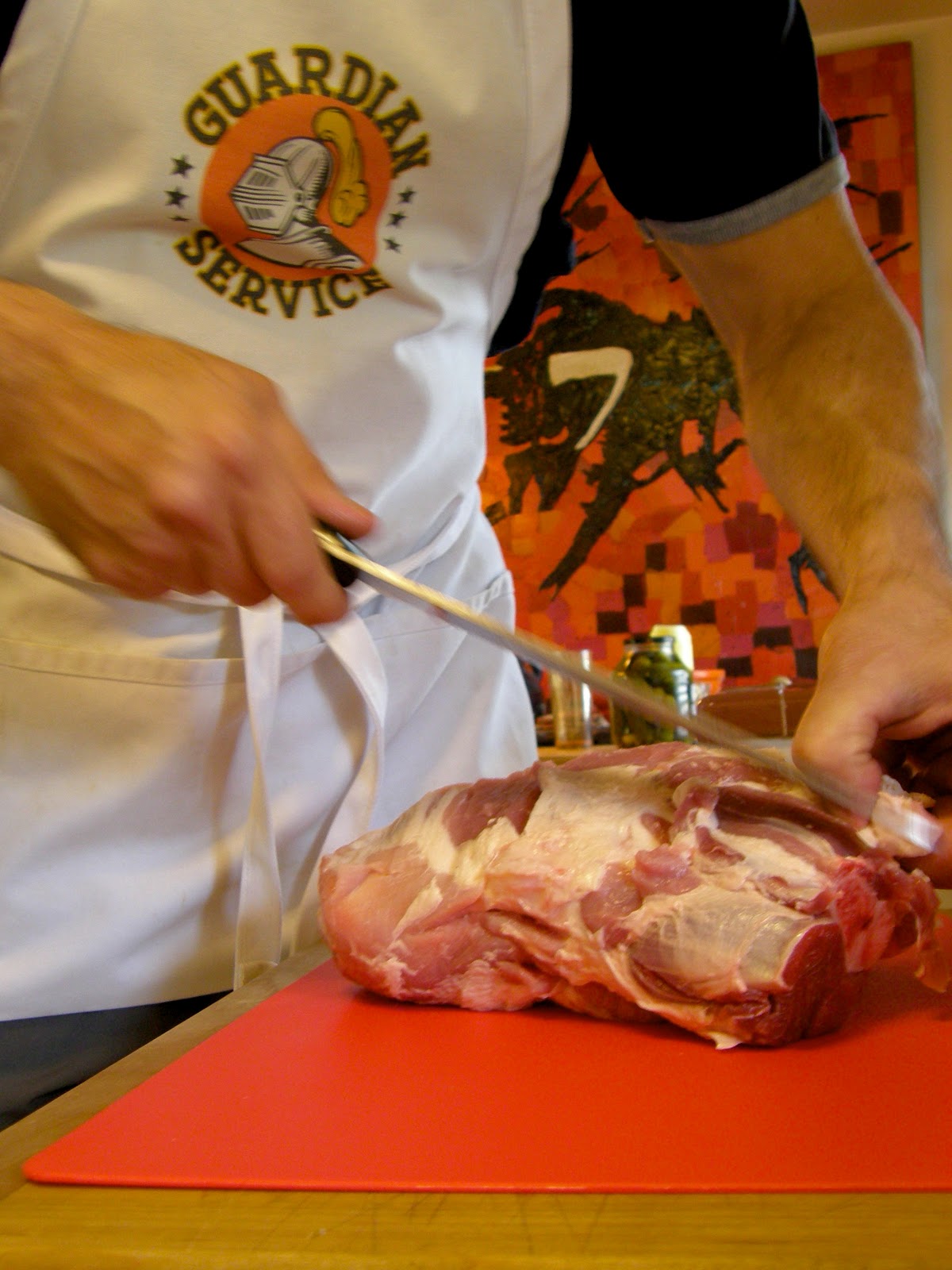
Trimming shoulder roast of exterior fat.
The roast, studded with garlic slivers and herbs, bedded in spring onions.

Apricot jam added to the barbecue sauce in the Guardian Service Dome Cooker.

Pulling the pork.

  1. Trim a large pork shoulder roast of its exterior fat and stud with garlic (use a paring knife to insert slivers of garlic).
  2. Line the base of the Guardian Service Roaster with chopped onion and spring onions. Position the prepared roast on the onion bed, cover and cook over LOW heat for 3 hours or more, checking on the hour, until it relaxes from the bone. NOTE: It's extremely important to keep the heat LOW. Turn the heat off at intervals over the course of cooking time (roughly half the time) or, if needed, vent the cover at an angle to keep too much heat from building up within the roaster.
  3. Meanwhile, in a large Guardian Service unit (pictured above, the 4 qt. straight-sided Guardian Service Dome Cooker) combine sauce ingredients and simmer over low heat until flavors marry (15 minutes). (Additional juice from the pork will further thin the sauce after incorporation).
  4. When roast is tender, cool and remove meat from the bone, discarding the fat and gristle. Notes Kathi Martin, "This is messy and tiresome, so be prepared… and get over it."
  5. Add meat to the simmering sauce and continue to cook over low heat until ready to serve (with coleslaw, by tradition!). 

Also: freezes exceptionally well, make extra or ahead to "get the mess over with at once with a summer's worth of BBQ."

Tuesday, February 9, 2010

Tuna Noodle Casserole... with integrity

Is any meal more comforting than a Tuna Noodle Casserole?

Though casserole recipes date back hundreds of years (made of anything from chicken or turkey to lobster or sweetmeats) the Tuna Casserole as we now know it didn't become an American staple until after the commercial canning of tuna in 1903 and a corporate promotional effort to encourage homemakers to use it as a protein alternative.

During the Great Depression, casseroles became increasingly popular as a means to extend the flavor of meat or fish to feed a whole family and Campbell Soup actively promoted their Cream of Mushroom Soup as an economical alternative to homemade sauces. From the 1930s through the 1950s, with the introduction of glass and lighter-weight metal cookware such Pyrex and Guardian Service, casseroles became quicker and easier to make and by the 70s, the rise of processed food led to the ubiquitous "Can-Can" Casserole (a can of tuna, a can of condensed mushroom or cheddar soup, a can of French's fried onions), robbing the dish of some of its wholesome elegance and sophistication.

A survey of casserole recipes from the 1940s forward reveals an increasing reliance on processed ingredients (what Michael Pollan refers to as "Dump-and-Stir" recipes). Obviously the first recipe using a can of Campbell's Cream of Mushroom soup was published by the company itself: in "Easy Ways to Good Meals: 99 Delicious Dishes Made With Campbell's Soups," 1941, we're advised, 
"Learn how to use Campbell's Soups in your casserole dishes. Discover what zestful flavor they give--what quick and easy substitutes for cream sauce some of them are--the precious minutes they save you in preparation--they make meals so attractive!"
In the 1946 edition of the stalwart "Joy of Cooking," even Irma Rombauer underscores the meal's convenience ("an excellent emergency dish") and uses a 16 oz can of mushroom soup. But of two Betty Crocker cookbooks I referenced, (the "Picture Cook Book," first edition, 1950 and "So You're Serving A Crowd," 1952), both include a white sauce rather a can of soup (although General Foods had more interest in selling flour and cereals than pre-packaged soups... and the second recipe is topped with Wheaties).

By 1965, the classic "Can-Can" Casserole had fully evolved into a warmed-over mess of pre-packaged foods. The Betty Crocker "Dinner in a Dish" calls for cans of not only soup, onions and tuna but canned macaroni and cheese too. Factories made that meal months ago—you're just warming it up.

While the Guardian Service Tested Recipes Cookbook doesn't include a recipe for Tuna Noodle Casserole, it has an easy Escalloped Salmon recipe which I've taken as a guide, employing whole ingredients and topped with fried leeks. Less sodium, less fat, fewer preservatives and more flavor, nutrition and, yes, integrity... and only one can—tuna—please.

TUNA NOODLE CASSEROLE
for the Guardian Service Casserole/Tureen

8 oz egg noodles, cooked and drained
2 tbsp butter, plus some to dot the crust
8 oz Crimini mushrooms, quartered
2 tbsp dry sherry
1 shallot, minced
2 celery stalks, diced
2 tbsp flour
1 cup milk
2 tbsp sour cream
1 tsp dried dill
1 tsp grated nutmeg
1 12 oz can albacore tuna in water
salt and pepper to taste
8 oz fresh or frozen sweet peas
1/2 cup bread, cracker or potato chip crumbs
1/4 cup grated Parmesan and/or cheddar cheese
1 leek, sliced into rings, fried in bacon fat and/or olive oil


In Guardian Service Cookware, prepare noodles in just enough water to cover.
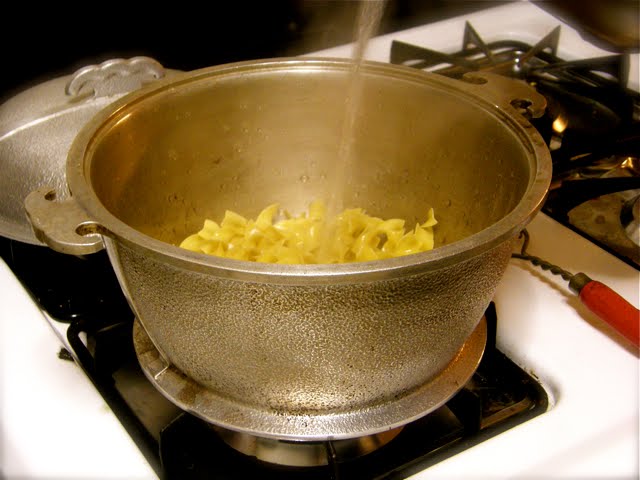
  1. Cook Egg Noodles in the Tureen unit: Place noodles in Tureen, add pinch of salt and cover with boiling water. Cover and let steam for 8-10 minutes (they should be slightly under cooked so they don't turn to mush when baked in the casserole). Drain noodles in a colander with cold water and set aside.
  2. Prepare the topping: Slice the leek into thin rings and fry in melted bacon fat and or olive oil until brown and crisp. Grate cheeses and crumb bread or crackers and set aside.
  3. In the Casserole dish, melt 1 tbsp butter and sauté mushrooms until they release some of their liquid. Add sherry and simmer another few minutes. Remove mushrooms and set aside. Add remaining tbsp butter to mushroom juices; add the onion and celery and sauté until translucent.
  4. Gradually sprinkle flour over mixture, stirring constantly until it forms a roux and browns. Add milk and sour cream gradually and continue to stir until thickened. Remove from heat and add seasoning. You may wish to mix in the cheeses as well, or save to top the crust.
  5. Drain one 1 large (12 oz) can of tuna fish and flake with a fork. ("Be careful not to mince it as that isn't nearly as good," notes Rombauer). Fold in the egg noodles, peas and fish, ending with some noodles on top.
  6. Cover the top with crumbs, cheese and fried leeks, dot with butter.
  7. Place the tureen inside the casserole and cover. Cook over medium to 2/3 flame for 30 minutes or until heated through.
  8. Optional: Brown the crust using the stove-top browning technique.
A white sauce replaces the "traditional" canned soup.
The Guardian Service Casserole-Tureen bakes casseroles stove-top.
For the true Guardian Service enthusiast: Stove-top browning


Friday, January 22, 2010

Vegetables, "The Guardian Service Way"

COOKING VEGETABLES
Of all the food we prepare with our Guardian Service cookware, vegetables shine—literally. The superior color and texture of vegetables prepared “The Guardian Service Way,” are a result of the nutrient-retaining method of waterless cooking. Of course, the real beauty is that those vitamins and minerals, which would go up in steam or down the drain in other cooking methods, will instead nourish you and your beloveds.
“Waterless” doesn't mean no water at all—in fact what you actually are doing is super-heating the water within the food itself as pressure slowly drives heat into the cells of the food, vaporizing its own juices.
photo: Chris Martin

THE BASIC METHOD
In brief, the technique is to get your Guardian Service pan hot at first to encourage steam, then turn the heat down to cook gently. Water vaporizes inside the vegetables’ cells, which stay intact, and every bite is delicious and nutritious.
First, clean and prep your vegetables, but with most, avoid peeling: it requires more scrubbing, but it preserves so much flavor and nutrition—another argument to buy organic produce when you can.
Remember that the finer something is chopped, the quicker it will cook. You can bake whole potatoes in GS (and they are spectacular) but to speed up the process, chop them—true for parsnips, carrots, turnips, beets, any of the starchy vegetables. When we want it fast, we chop it fine, but if we’re not in a hurry, we quarter them or chop them in half and let them linger on low flame for a bit longer.
After cleaning and prepping your vegetables, place them in an unheated, corresponding-sized pot and rinse them with a small amount of cold water (1/2 cup or so), then pour off the excess liquid. That small amount of moisture is all that’s needed. You may notice that discarded water is already tinged with the vegetables’ color from a quick cold rinse—just imagine what you lose when you boil...
Cover unit and set over medium heat for 5 minutes or until the lid is warm to the touch. Within minutes you'll see steam rolling down the inside of the glass lid like a delicious science project. Now turn the heat way, way down, until (if you’re cooking with gas) the flame is barely flickering.
Check for doneness after 15 minutes or so, depending on the vegetable. You may wish to add a pat of butter and dash of salt, then stir or shake and serve (right in the unit—another economic benefit: each Guardian Service piece is designed to go from stove to table-top, so there are fewer pots to clean).

SCRAPS AND TRIMMINGS AREN'T GARBAGE
We typically reserve organic vegetable scraps in a freezer bag, then cook them down into soup stock when we have a surplus. But some trimmings can be profitably cooked right along with your vegetables. For example, broccoli: instead of throwing out the woody stalks, lay them at the bottom of the pot, then layer the broccoli florets on top. As you cook them together, the stalks will protect the upper florets and suffuse them with extra moisture, flavor, and even vitamins.

FRUGALITY AND ECONOMY FOR THE NEW DEPRESSION
Guardian Service is Depression-era cooking not only because of the conservation of nutrition but because it is incredibly frugal with carbon (meaning heating energy, whether gas or electric). Aluminum is highly efficient at conducting and retaining heat, and when the amount of heat that is streaming into the pan from the burner equals the amount of heat radiating off the outside, your food cooks at its ideal temperature. The technique “slow cooks” your food (but quickly!) with the heat that is initially built up inside the metal.

KEEP YOUR LID ON
It's common sense: keeping the lid on conserves heat and moisture. You may have noticed the succulent aromas sealed inside the lid, which only escape when you lift it. This is key to flavor—aromas are flavor essence, and scents that are in your kitchen, delightful as they may be, are in the air, not in your food.

10 STEPS OF VEGETABLE PREPARATION
(Excerpt from the 1935 "GUARDIAN SERVICE Tested Recipes" Cookbook by "Director, Betty Gay")
  1. Wash vegetables carefully, even though they look clean. Scrub, remove only decayed portions and tough outer stalks or leaves as necessary. Remember, when you are tempted to peel—vital food values are wasted in parings. A wire vegetable brush is less of a culprit than the paring knife.
  2. Select a GUARDIAN SERVICE unit that corresponds in size to quanity of vegetable.
  3. Place in unheated unit. If vegetables are not strictly fresh or if, when peeled, some of the natural moisture has been removed, then replace moisture by adding a very small amount of water. This also applies in the case of preparing a small quantity of food in a large unit, there being insufficient moisture in the food to fill the unity with vapor.
  4. Cover unit and start over MEDIUM HEAT. Never use high heat. Heat will spread evenly and quickly to every part of your GUARDIAN SERVICE unit. Too much heat at first may cause food to stick before vapor has formed with unit.
  5. Keep on MEDIUM flame about 5 minutes, until cover of unit becomes quite warm to touch.
  6. Reduce heat to LOW. Do not wait for vapor to escape before reducing heat. Escaping vapor, at any time, means that flame is too high. Low heat will be as easy on the vegetables as on the fuel bill.
  7. Season any time after vapor forms. Because rich, natural mineral salts and juices are largely retained, very little or no seasoning is required. The addition of butter just before serving is sufficient in most cases. Never, never add soda to vegetables as it not only gives them an artificial appearance, but actually breaks down the fiber and destroys flavor and vitamin content.
  8. Avoid lifting covers unnecessarily during preparation period as this prolongs time and allow vapor to escape. Raising the heat will not speed up the process, and may cause food to dry out and stick or burn.
  9. Test for tenderness at end of preparation period (See time chart, page 9.) Vegetables are done when tender, but still firm and natural in color. Do not soften to mushy, breaking apart stage.
  10. GUARDIAN SERVICE is constructed to retain heat over a long period of time. Therefore to prevent loss of color through over cooking, remove cover from the following vegetables as soon as tender: Asparagus, broccoli, brussels sprouts, green beans, peas, greens, cabbage and cauliflower.