Showing posts with label vegetables. Show all posts

Monday, September 12, 2011

Guardian Service Demonstration Dinner

In its day, Guardian Service ware was sold door-to-door, often at neighborhood parties where a salesman would prepare a demonstration dinner. Similar to the later Tupperware parties, the sales strategy relied on showing the product to the customer first-hand. The salesmen prepared and presented meals to highlight their pitch: the economic and nutritional advantages of waterless cooking the "Guardian Service Way." The hostess would receive a caddy of highball glasses with matching coasters or candlesticks or salt and pepper set, or other such gift. These dinners were often publicized with listings in the social register, such as the one pictured below.

A typical Guardian Service Demonstration Dinner notice
from the Granite Falls Press, WA (June 19, 1947)
Last week we recreated the Guardian Service Demonstration Dinner (while trying to keep our "Knights of Nutrition" proselytizing on medium low). We packed up the Guardian Service Roaster, Duplex Pan and Economy Trio Cookers, and the Beverage Urn and Coffee Maker and prepared a dinner for eight at our friend Nancy's home in Venice. Among those in attendance were our friend Dirk (who we discovered had sold waterless cookware in his college years) and Sam Watters (author of the LA Times' Lost LA feature on our Guardian Service cookware collection).

We wanted to cook an elegant dinner that would showcase the key advantages of Guardian Service Ware (the economy and nutrition of stove-top, waterless cooking) with fresh, local, seasonal fare, so we left planning the menu until we shopped our ingredients, starting with the cut of meat.

The family farm on which I was raised in North Dakota maintains a small herd of free-range beef cattle which are integral to its organic, bio-dynamic, self-sustaining ecosystem. Here in Los Angeles, we're fortunate to receive most of the red meat we consume from my family's farm, so we never really consider buying beef raised in a feed-lot Cowschwitz. Regular outbreaks of food-born illness have heightened public awareness of the health and environmental risks involved in raising and eating hormonally and genetically modified animals. Whenever possible, we look for a butcher who sources meat from ranches employing ethical, humane practices.

We've been reading and hearing about Lindy & Grundy for over a year and thought what better way to showcase the Guardian Service Roaster than with something special from this excellent charcuterie?

Proprietress Amelia Posada greeted us at the door with a friendly hello—fresh as milk, raven hair tied up in a red kerchief with Bow lips stained to match, a Rosie the Riveter of the Rib Roast. I told her what I had in mind and how many we were serving and she presented a butterflied leg of lamb, artfully trimmed and aged to perfection (and as with all their meats, local, pastured and organic). We'll be back to try the half beef/half bacon ground mix Amelia recommends for a blue cheese-topped burger…

As we shopped for produce at the Farmers Market at Fairfax and 3rd, I surfed some recipe sites for inspiration. All the local organic vegetables and spices we needed were available for the seasonal Persian lamb dish below. We altered a few ingredients from the original recipe, roasting the garlic and jalapeño in advance to mellow and sweeten their effects on the meat.

We prepared one pot each of carrot coins, red and white new potatoes and red and white cabbage in the Guardian Service Economy Trio Cookers (or "triangle pans" as they're often called). And for dessert: a lemon pound cake cooked stove-top in the Duplex Utility Pan, topped with fresh strawberries muddled with brown sugar and plain yogurt and served with Guardian Service Coffee.

Roast Garlic Stuffed Leg of Lamb
inspired by Fakdeh Mehshi Khodra

2 cups chopped fresh flat-leaf parsley
1 cup chopped fresh mint leaves
25 cloves garlic, peeled, roasted and mashed
2 Tbsp olive oil
1/2 tsp finely chopped jalapeño pepper
2-3 carrots, sliced in half lengthwise
1 large onion, quartered
1/2 tsp ground allspice
1/2 tsp grated nutmeg
1/2 tsp ground cloves
1 tsp fresh ginger, minced
2 tsp salt
1 tsp black pepper
4 1/2 pounds boneless leg of lamb, butterflied, trimmed of excess fat, rinsed, and patted dry
1 pound onions, halved
1/4 cup apple cider vinegar
1 cup red wine*
1 Tbsp cornstarch or flour

*Verjus, a sour grape juice, is traditional for a Muslim recipe. Vinegar and wine are a fine substitute.

  1. Lightly coat 2 dozen peeled garlic cloves in a small or medium sized pot. Cover and place over medium high heat for 5 minutes, until lid is warm to touch, reduce heat to low and roast for 30 minutes, shaking pot occasionally to keep cloves from sticking.
  2. Add minced jalapeños and continue to roast additional 5-10 minutes. Remove pot from heat and allow to cool.
  3. Using a food processor or blender, blend the roast garlic and jalapeño together with chopped mint and parsley and set aside.
  4. Rub the dry spices and ginger into the prepared cut of meat, massaging well.
  5. Spoon a ribbon of the garlic paste into the center of the cut and roll into a roast, securing with kitchen twine.
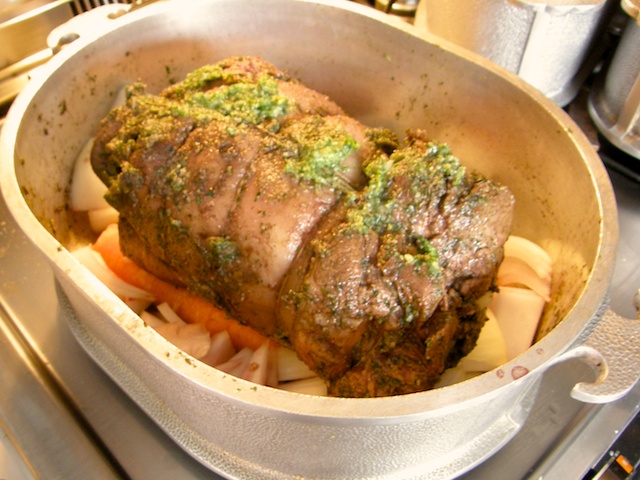
  6. Heat 1-2 Tbsp of olive oil in the Guardian Service Roaster over medium heat and coat bottom of pan well. Add the roast, searing each side for 90 seconds. Remove roast, add the halved carrots and quartered onion to the bottom of the roaster to form a cooking rack to support the roast. Return roast to pan, add any remaining garlic paste to the top,  and sprinkle generously with cider and wine.
  7. Cover and cook over medium low heat for 1.5 to 2 hours, depending on desired temperature of the finished roast. Allow to rest for 15 minutes, carve and transfer to the Guardian Service Roaster platter. Garnish with roasted carrot and onion and cover until ready to serve.
  8. Reduce the remaining roast and vegetable drippings over medium low heat, adding a tablespoon of cornstarch or flour mixed an equal amount of water or wine to the gravy to thicken, if desired. Serve with roast and vegetables.
Rubbing spices into the lamb

Adding the roast garlic-jalapeño-mint-parsley paste

Rolling and trussing the roast with kitchen twine

Searing all sides of the roast seals in the moisture
The prepared leg of lamb resting on a vegetable rack, ready cover and roast
For advice on preparing the carrots, potatoes and cabbage, visit our previous blog post on cooking vegetables the "Guardian Service Way."

Guardian Service Lemon Pound Cake
Adapted for the Guardian Service Duplex Utility Pan. Serve warm or cold. Make ahead, freezes well.
1/2 pound (2 sticks) butter
1/2 cup sugar, more if desired
4 eggs, beaten
2 lemons, juice and zest
3/4 cup milk
1/2 cup sour cream
2 1/2 cups flour
1 tsp baking soda
1 tsp baking powder
1/2 tsp salt
  1. Blend butter until creamy, add sugar, then eggs and lemon juice and zest.
  2. Sift together remaining dry ingredients and fold together with remaining wet ingredients.
  3. Spoon into heated, buttered Duplex Utility pan, close and cook for 13-15 minutes on medium low heat. Flip pan and cook additional 13-15 minutes.
  4. Remove from heat and allow to rest unopened an additional 10-15 minutes.
  5. Open pan and gently run a knife along the edge of the cake to loosen, remove to baking rack and cool. Slice and serve with fresh strawberries and yogurt.
Tasty cake, stove-top
Don't miss our other blog posts with recipe ideas for the Guardian Service Duplex Utility Pan and instructions for making Guardian Service Coffee.


Wednesday, December 1, 2010

Butternut Squash Bisque

Denver's Brown Palace Butternut Squash Bisque, garnished with salad burnet.
As a friend who stopped by to taste this soup remarked, "Oh, that's not good... that's  ffffffive–star brilliant." Indeed it is: at the turn of the century, this bisque was served at Denver's Brown Palace Hotel, the first atrium–style hotel ever built and host to the "Unsinkable" Molly Brown, Theodore Roosevelt and Queen Marie of Romania among others.

The recipe comes to us through Andrew's mother, Kathi, whose mother and grandmother were among the "Beautiful People of Denver." Andrew, an expert soup chef, has adapted this family favorite to take advantage of our Guardian Service cookware. Rather than boil the vegetables, we stove–top roast the squash and potatoes first, then mash. The perfect caramelization of the vegetables adds fantastic depth to an already rich soup. Plus, the waterless technique preserves nutritive value and flavor, helping to make up for this soup's truly staggering Gilded Age dairy fat content. Serve it in small portions... but they'll all want seconds. Andrew reminds us: like all soups, this improves over days and freezes beautifully. Plus, it is excellent served chilled.

Butternut Squash Bisque
from Denver's Brown Palace
(adapted for Guardian Service Ware by Andrew Martin) 

1 1/2 lbs butternut squash, peeled, seeded.
1 lg sweet potato peeled
1 qt milk 
Pinch each nutmeg and cinnamon
2 T. honey
1 tsp. pure maple syrup
2 T. mascarpone cheese
2 T. creme fraiche
1/2 c heavy cream
1/2 dry sherry
salt and pepper to taste

1) Roast the squash and sweet potatoes the Guardian Way, whole or in chunks, in a large cooker (pictured: the Guardian Service Chicken Roaster) until soft enough to mash with a potato masher. Low heat, about thirty minutes and a bit.
2) Let cool a bit, then mash the sweet potato/squash until smooth.
3) In bowl, add milk to the mash, and mix in remaining ingredients, blending until smooth. To give it a nice texture we used an egg-beater, but a blender or food-processor may suit you.
4) Pour into Guardian Service Tureen. Stirring constantly, bring soup back to a gentle simmer and cook 5 minutes. Salt and pepper to taste. If too thick, add more milk and adjust seasoning. Makes 2.5 quarts.

Monday, September 27, 2010

NY Times: America Hates Vegetables

Photo: Chris Martin
This weekend a NY Times article titled "Told to Eat Its Vegetables, America Orders Fries" was picked up as Huffington Post's lead story and subsequently around the blogosphere. Frankly, I pity the lot of them—the author and her interviewees. Kim Severson goes to great lengths to support a view that preparing vegetables is hard work, time-consuming and expensive. She writes:
People know that vegetables can improve health. But they’re a lot of work. In refrigerators all over the country, produce often dies a slow, limp death because life becomes too busy.
Now, I'll grant you, at the end of a long day, washing and chopping a head of broccoli can seem like a lot of work, might even seem time-consuming, but... really? She goes on:
In the wrong hands, vegetables can taste terrible. And compared with a lot of food at the supermarket, they’re a relatively expensive way to fill a belly.
If you boil a vegetable until it's dead, it will taste terrible. But to argue that "they're a relatively expensive way to fill a belly" is infuriating. Expensive relative to what? A triple-bypass? She goes on:
...a busy Manhattan resident who works for a pharmaceuticals company, would eat more vegetables if they weren’t, in her words, “a pain.”
“An apple you can just grab,” she said. “But what am I going to do, put a piece of kale in my purse?”
For weeks last March, the NY Times' most popularly emailed article was two simple recipes for that super health food, kale. Or, try an even simpler solution for a single serving on-the-go: Rip a few leaves of kale into bite-size pieces, muddle them with some salad dressing and chill them overnight. The acids in the dressing will "cook" the greens enough to make them a tender snack for lunch the next day. Stick that in your purse.
And the Times' last word? That summary statement is given to an analyst for a global marketing firm:
“Eating vegetables is a lot less fun than eating flavor-blasted Doritos,” said Marcia Mogelonsly, a senior analyst for Mintel, a global marketing firm. “You will always have to fight that.”
I admit that we have serious problems in our nation's "food deserts," where fresh produce is not readily available. And cooking for one person isn't easy, especially if you spend most of your day away from home. And, whether for one or a household, cooking requires planning and work.
This article promotes the idea that fresh-cooked vegetables have to defend themselves and compete in a marketplace with junk food and  panders to an America resigned to the Snack Food industry, deaf to social food movements and hopelessly addicted to greasy boxes of salty transgenic Frankenfoods.
We propose that perfectly cooked vegetables, crisp, juicy, abounding in flavor and nutrition and minimally processed (as is the Guardian Service Way) are incomparable to fast "food" and we invite writers and readers of the NY Times to take 15 minutes and try for themselves.

Tuesday, August 3, 2010

Guardian Service Backyard Tandoori


We were spared the scorching temperatures that socked most of the nation last month, but yesterday's warmer weather drove us out of doors rather than face heating up the kitchen for dinner. Our improvised meal was not only memorably delicious, but a solid adaptive use of Guardian Service cookware—a Pan-Asian Fusion meal undreamed of by the cookware's designers, yet one that honors their tenets of nutrition and economy in our common pursuit of "Good Health, Pleasure and Profit."

This method is inspired by tandoori* cooking, though instead of a clay oven, we use a portable 14 1/2" charcoal grill and our Guardian Service Casserole unit. When the coals are hot, the Casserole unit builds up a head of steam, gently cooking the vegetables at the grill's center, while the meat is grilled on the perimeter. The seared meat is then added to the mix. As the fire cools, it finishes the meal at the perfect low temperature required for "waterless cooking" with Guardian Service Ware.

Guardian Service Backyard Tandoori
(Five basic steps. Try any combination of vegetables and/or meats.)
  1. Marinate the meat or fowl.
  2. Layer the vegetables in the Casserole unit according to cooking time required—fibrous vegetables (carrots, celery, turnips, parsnips) in a "basket" layer (the bottom and sides), starchier vegetables (potatoes, sweet potatoes) to the center and the juicier, more delicate vegetables, which require little to no cooking, on top (tomatoes, onions, cauliflower, peppers).
  3. Place the covered unit over a small amount of charcoal (12-15 briquettes) in the center of the grill.
  4. Grill the meat: place the pieces of marinated meat around the outside edge of the grill, searing the outside edges until brown. (We use the Guardian Service Economy Trio trivet to prevent grill marks from burning into the Casserole, but it's not a necessity).
  5. As the meat browns, place each seared piece into the Casserole along with any remaining marinade and cover. Finishing cooking for 30 minutes.


Note the color retention in the vegetables (and thus nutritional retention) from start to finish. The low, constant, contained heat of the waterless cooking method creates an incredibly nutritious meal and works wonders with inexpensive cuts of meat and any variety of vegetables and sauces.


Andrew improvised a Chicken Masala Tandoori last night employing the above method (carrots, sweet potatoes, heirloom tomatoes, cauliflower, jalapeño peppers, scallions, basil and chicken thighs marinated in Masala Sauce  with sesame oil, juice of half a lemon, juice of half an orange, salt and pepper). Served withbread and chutney. Bon Appétit!

Chef Andrew. Not only does he cook an outstanding meal, but he suffers this dopey apron. And he's kinda cute too... I guess he can stick around.
*A true tandoor is made of clay and is used throughout India, the Middle East and Central Asia and employs high temperature cooking in a cylindrical clay oven or a grill. Andrew combined the grilled, smoked effects of tandoori cooking, with the slow, low heat requirements of Guardian Service Ware.
* * * * * * *
Stretch the fuel economy even further? As dinner was served, we placed a carafe of water over the remaining coals, enough fuel to bring it to a boil and brew a pot of Guardian Service Coffee (with dessert accents of fennel and cinnamon added to the grounds).

Friday, January 22, 2010

Vegetables, "The Guardian Service Way"

COOKING VEGETABLES
Of all the food we prepare with our Guardian Service cookware, vegetables shine—literally. The superior color and texture of vegetables prepared “The Guardian Service Way,” are a result of the nutrient-retaining method of waterless cooking. Of course, the real beauty is that those vitamins and minerals, which would go up in steam or down the drain in other cooking methods, will instead nourish you and your beloveds.
“Waterless” doesn't mean no water at all—in fact what you actually are doing is super-heating the water within the food itself as pressure slowly drives heat into the cells of the food, vaporizing its own juices.
photo: Chris Martin

THE BASIC METHOD
In brief, the technique is to get your Guardian Service pan hot at first to encourage steam, then turn the heat down to cook gently. Water vaporizes inside the vegetables’ cells, which stay intact, and every bite is delicious and nutritious.
First, clean and prep your vegetables, but with most, avoid peeling: it requires more scrubbing, but it preserves so much flavor and nutrition—another argument to buy organic produce when you can.
Remember that the finer something is chopped, the quicker it will cook. You can bake whole potatoes in GS (and they are spectacular) but to speed up the process, chop them—true for parsnips, carrots, turnips, beets, any of the starchy vegetables. When we want it fast, we chop it fine, but if we’re not in a hurry, we quarter them or chop them in half and let them linger on low flame for a bit longer.
After cleaning and prepping your vegetables, place them in an unheated, corresponding-sized pot and rinse them with a small amount of cold water (1/2 cup or so), then pour off the excess liquid. That small amount of moisture is all that’s needed. You may notice that discarded water is already tinged with the vegetables’ color from a quick cold rinse—just imagine what you lose when you boil...
Cover unit and set over medium heat for 5 minutes or until the lid is warm to the touch. Within minutes you'll see steam rolling down the inside of the glass lid like a delicious science project. Now turn the heat way, way down, until (if you’re cooking with gas) the flame is barely flickering.
Check for doneness after 15 minutes or so, depending on the vegetable. You may wish to add a pat of butter and dash of salt, then stir or shake and serve (right in the unit—another economic benefit: each Guardian Service piece is designed to go from stove to table-top, so there are fewer pots to clean).

SCRAPS AND TRIMMINGS AREN'T GARBAGE
We typically reserve organic vegetable scraps in a freezer bag, then cook them down into soup stock when we have a surplus. But some trimmings can be profitably cooked right along with your vegetables. For example, broccoli: instead of throwing out the woody stalks, lay them at the bottom of the pot, then layer the broccoli florets on top. As you cook them together, the stalks will protect the upper florets and suffuse them with extra moisture, flavor, and even vitamins.

FRUGALITY AND ECONOMY FOR THE NEW DEPRESSION
Guardian Service is Depression-era cooking not only because of the conservation of nutrition but because it is incredibly frugal with carbon (meaning heating energy, whether gas or electric). Aluminum is highly efficient at conducting and retaining heat, and when the amount of heat that is streaming into the pan from the burner equals the amount of heat radiating off the outside, your food cooks at its ideal temperature. The technique “slow cooks” your food (but quickly!) with the heat that is initially built up inside the metal.

KEEP YOUR LID ON
It's common sense: keeping the lid on conserves heat and moisture. You may have noticed the succulent aromas sealed inside the lid, which only escape when you lift it. This is key to flavor—aromas are flavor essence, and scents that are in your kitchen, delightful as they may be, are in the air, not in your food.

10 STEPS OF VEGETABLE PREPARATION
(Excerpt from the 1935 "GUARDIAN SERVICE Tested Recipes" Cookbook by "Director, Betty Gay")
  1. Wash vegetables carefully, even though they look clean. Scrub, remove only decayed portions and tough outer stalks or leaves as necessary. Remember, when you are tempted to peel—vital food values are wasted in parings. A wire vegetable brush is less of a culprit than the paring knife.
  2. Select a GUARDIAN SERVICE unit that corresponds in size to quanity of vegetable.
  3. Place in unheated unit. If vegetables are not strictly fresh or if, when peeled, some of the natural moisture has been removed, then replace moisture by adding a very small amount of water. This also applies in the case of preparing a small quantity of food in a large unit, there being insufficient moisture in the food to fill the unity with vapor.
  4. Cover unit and start over MEDIUM HEAT. Never use high heat. Heat will spread evenly and quickly to every part of your GUARDIAN SERVICE unit. Too much heat at first may cause food to stick before vapor has formed with unit.
  5. Keep on MEDIUM flame about 5 minutes, until cover of unit becomes quite warm to touch.
  6. Reduce heat to LOW. Do not wait for vapor to escape before reducing heat. Escaping vapor, at any time, means that flame is too high. Low heat will be as easy on the vegetables as on the fuel bill.
  7. Season any time after vapor forms. Because rich, natural mineral salts and juices are largely retained, very little or no seasoning is required. The addition of butter just before serving is sufficient in most cases. Never, never add soda to vegetables as it not only gives them an artificial appearance, but actually breaks down the fiber and destroys flavor and vitamin content.
  8. Avoid lifting covers unnecessarily during preparation period as this prolongs time and allow vapor to escape. Raising the heat will not speed up the process, and may cause food to dry out and stick or burn.
  9. Test for tenderness at end of preparation period (See time chart, page 9.) Vegetables are done when tender, but still firm and natural in color. Do not soften to mushy, breaking apart stage.
  10. GUARDIAN SERVICE is constructed to retain heat over a long period of time. Therefore to prevent loss of color through over cooking, remove cover from the following vegetables as soon as tender: Asparagus, broccoli, brussels sprouts, green beans, peas, greens, cabbage and cauliflower.