Showing posts with label Guardian Service Roaster. Show all posts

Thursday, November 22, 2012

Guardian Service Roast Turkey and Gravy


Happy Thanksgiving! Here is our annual post on the Guardian Service stove-top method for roast turkey and my own family's gravy recipe, adapted for Guardian Service Ware. A Happy Thanksgiving from our family to yours—in Good Health, Pleasure and Profit!
Carving the roast turkey, prepared stove-top with the Guardian Service Roaster.

Guardian Roast Turkey

1) Prepare the turkey (bring to room temperature, remove the neck and giblets from the cavity and rinse thoroughly, pat dry and salt the bird, inside and out). Lather with butter, stuff and truss. In a medium pan (we used the 2 qt dome cooker), roast the neck and giblets over a layer of celery and garlic for an hour, then add water and continue to simmer on low until you're ready to add it to the stuffing and/or gravy (see below).

2) Over a medium burner, heat 2 Tbsp. fat and 2 Tbsp. butter in roaster and coat pan well. Place turkey in roaster and sear, browning all surfaces of the bird, 90 seconds per plane so that the skin caramelizes. (This keeps the juices inside the turkey as it cooks). Be bold! We used two large spatulas, rolled the bird in the pan, and grabbed it with a clean towel. Properly trussing the bird can take some handling. Remove turkey from pan; pouring off and reserving excess fat. Place turkey on its breast on roaster rack and lower into roaster. Cover with lid and cook over both burners at low heat for 15-20 min/lb.

3) Halfway through the roasting period, flip the bird—that is, turn it to  distribute the juices. Remove the roaster lid and invert it as a resting tray, then remove the rack from the roaster and place turkey in the lid. Turn the turkey on its back, reposition on the rack and return it to the roaster to continue cooking. 

4) The turkey is done when its juices run clear, the wings give and the thigh meat reaches 165℉. Now comes the fun part, finishing by browning the turkey using the deflected heat of the Guardian Service stove-top browning technique. Set roaster to one side of stove, remove lid and position it so it channels the heat over the turkey. Now you are a knight using his shield to roast his catch over an open fire! Turn it any way you please, letting each side of the turkey get a good toasting. Meanwhile baste well to give a healthy brown glaze. 

The Lee-Peterson-Robinson Gravy

My mother's family's method for making gravy is a long-held tradition passed down through my great grandmother Ruth Lee Peterson, as Yankee a Puritan as they came. The method is simple, but requires patience and diligence, for which you'll be rewarded with unparalleled flavor.

1) Over medium heat, reduce the roaster pan drippings until they caramelize and stick. NOTE: It can take 30-40 minutes for the sugar in the drippings to properly caramelize and the fat to separate and run clear. During this window it is crucial that you ignore your nagging doubt and the hand-wringing of loved-ones who think you're burning the gravy and wondering why dinner is getting cold and why you're ruining this festive occasion... Patience—and DON'T SCRAPE the bottom of the pan.

2) When the fat separates from the browned turkey drippings, pour off all but a Tbsp or two of the excess fat and return the roaster to a low heat. NOTE: Because the Guardian Service pan heats evenly, it's harder to get drippings to really hold to the bottom of the pan*. (We used a free-range bird which has very little fat—just enough for the following step, the roux—but if you're cooking a Butterball, you may need a gravy separator for this step).

3) Whisk 2-3 Tbsp. of flour into the giblet stock and add gradually to the roaster, de–glazing the pan and blending continuously until smooth and thick. Salt and pepper to taste and serve. (Note: You can also use leftover water from boiling potatoes (or  pasta) to de-glaze the pan, in which case there's no need for the extra flour—but if you're using the "waterless method" to cook your potatoes, you may not have any starchy water handy!).

Optional: for a heartier gravy, use a blender to incorporate the roasted neck and giblet meat (first removing meat from the neck bones) into some of the giblet stock and add to gravy as well.

*Don't fear a clean-up nightmare—the even heating of the Guardian Service cookware means an easier clean up than cheaper enamel pans which are more likely to scorch.

Wednesday, March 14, 2012

Pork Barbecue (or "Pulled Pork," North Carolina style)


If you own Guardian Service Cookware, you have at your fingertips everything you need to explore the ancient cooking method of barbarcoa or barbecue, slow-cooking meat until it falls off the bone. Regional barbecue recipes have spurred competitions and festivals worldwide, but this pork barbecue recipe is a favorite of Andrew's family (a gift from Harold Hutchins, a family friend and native of North Carolina). We've further adapted the recipe for Guardian Service Cookware.
In Western North Carolina, "barbecue" refers to pork shoulder, typically slow-cooked in foil over coals. The Guardian Service method, slow-roasting on low radiant heat until the meat is soft enough to pull from the bones, beautifully simulates coal-roasting. After roasting and pulling, the shredded meat is added to the prepared sauce and simmered further.
The original recipe is classic Depression Era cooking—turning a difficult, muscular cut of darker meat into a delectable meal. This recipe transforms a cheap cut with a few supermarket items (8 oz. of "Catalina" Russian salad dressing and ketchup, a package of onion soup mix, vinegar, worcestershire, tabasco and apricot jam).
We took it as a challenge to use fewer prepared foods containing multiple (or mystery) ingredients. All the sauce ingredients up to the apricot jam replace the aforementioned dressing and soup mix. We've also added spring herbs, garlic and onions to infuse the meat during the roasting process. (Note that the original recipe also calls for the roast to be wrapped in foil, a technique we'll experiment with and post again about here).

Guardian Service Pork Barbecue
(or "Pulled Pork," Western North Carolina style)
Barbecue Sauce
2/3 cup tomato paste
1/3 cup apple cider vinegar
1 tsp dry mustard (i.e., Colman's)
1 tsp cinnamon
1 tsp ginger
1 tsp cumin
2 Tbsp blackstrap molasses
1 Tbsp honey
1/3 cup brown sugar
2 Tbsp dried minced onion
1/2 cup apricot preserves
1 Tbsp Worcestershire sauce
2/3 cup ketchup
additional vinegar, pepper sauce, smoked salt to taste

Pork Roast
1 large pork shoulder roast, trimmed
4 cloves garlic, sliced into slivers
1 sprig bay leaves
2 sprigs rosemary
1 onion, chopped
5-6 spring onions
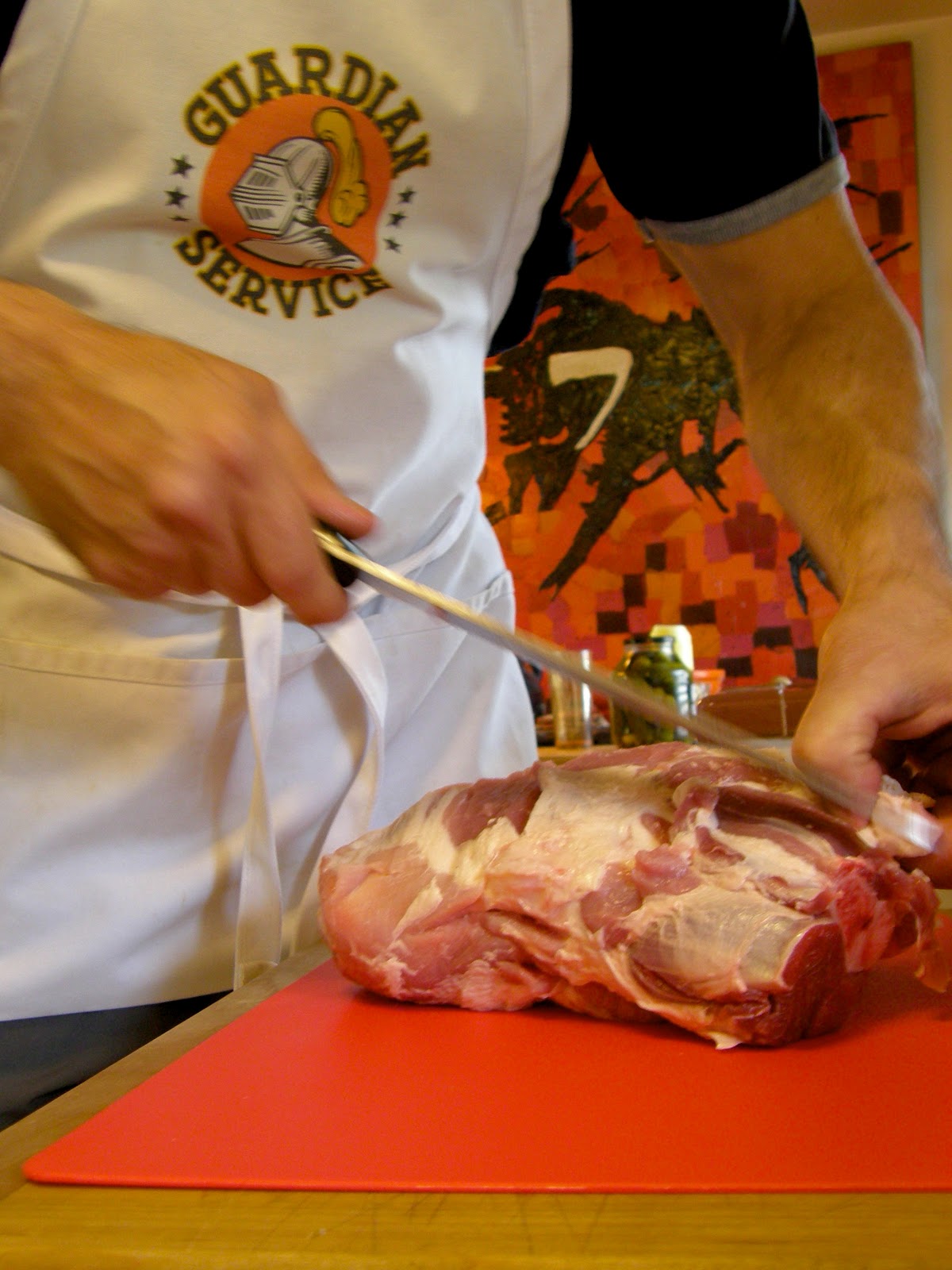
Trimming shoulder roast of exterior fat.
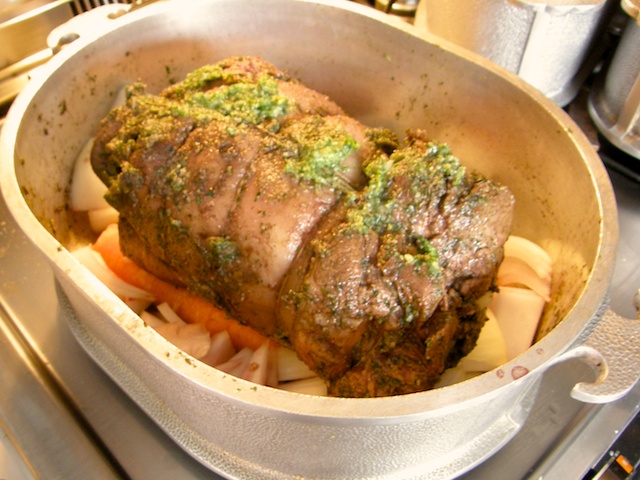
The roast, studded with garlic slivers and herbs, bedded in spring onions.

Apricot jam added to the barbecue sauce in the Guardian Service Dome Cooker.

Pulling the pork.

  1. Trim a large pork shoulder roast of its exterior fat and stud with garlic (use a paring knife to insert slivers of garlic).
  2. Line the base of the Guardian Service Roaster with chopped onion and spring onions. Position the prepared roast on the onion bed, cover and cook over LOW heat for 3 hours or more, checking on the hour, until it relaxes from the bone. NOTE: It's extremely important to keep the heat LOW. Turn the heat off at intervals over the course of cooking time (roughly half the time) or, if needed, vent the cover at an angle to keep too much heat from building up within the roaster.
  3. Meanwhile, in a large Guardian Service unit (pictured above, the 4 qt. straight-sided Guardian Service Dome Cooker) combine sauce ingredients and simmer over low heat until flavors marry (15 minutes). (Additional juice from the pork will further thin the sauce after incorporation).
  4. When roast is tender, cool and remove meat from the bone, discarding the fat and gristle. Notes Kathi Martin, "This is messy and tiresome, so be prepared… and get over it."
  5. Add meat to the simmering sauce and continue to cook over low heat until ready to serve (with coleslaw, by tradition!). 

Also: freezes exceptionally well, make extra or ahead to "get the mess over with at once with a summer's worth of BBQ."

Thursday, November 17, 2011

Roast Turkey and Gravy

With Thanksgiving week upon us, I thought I'd again post the Guardian Service stove-top method for roast turkey and my own family's gravy recipe, adapted for Guardian Service Ware. A Happy Thanksgiving from our family to yours—in Good Health, Pleasure and Profit!


Guardian Roast Turkey

1) Prepare the turkey (bring to room temperature, remove the neck and giblets from the cavity and rinse thoroughly, pat dry and salt the bird, inside and out). Lather with butter, stuff and truss. In a medium pan (we used the 2 qt dome cooker), roast the neck and giblets over a layer of celery and garlic for an hour, then add water and continue to simmer on low until you're ready to add it to the stuffing and/or gravy (see below).

2) Over a medium burner, heat 2 Tbsp. fat and 2 Tbsp. butter in roaster and coat pan well. Place turkey in roaster and sear, browning all surfaces of the bird, 90 seconds per plane so that the skin caramelizes. (This keeps the juices inside the turkey as it cooks). Be bold! We used two large spatulas, rolled the bird in the pan, and grabbed it with a clean towel. Properly trussed the bird can take some handling. Remove turkey from pan; pouring off and reserving excess fat. Place turkey on its breast on roaster rack and lower into roaster. (Optional: we added two whole jalapeños to the roaster to scent the bird and compliment the Californio theme of our stuffing—see below). Cover with lid and cook over both burners at low heat for 15-20 min/lb.

3) Halfway through the roasting period, flip the bird—that is, turn it to  distribute the juices. Remove the roaster lid and invert it as a resting tray, then remove the rack from the roaster and place turkey in the lid. Turn the turkey on its back, reposition on the rack and return it to the roaster to continue cooking. 

4) The turkey is done when its juices run clear, the wings give and the thigh meat reaches 165℉. Now comes the fun part, finishing by browning the turkey using the deflected heat of the Guardian Service stove-top browning technique. Set roaster to one side of stove, remove lid and position it so it channels the heat over the turkey. Now you are a knight using his shield to roast his catch over an open fire! Turn it any way you please, letting each side of the turkey get a good toasting. Meanwhile baste well to give a healthy brown glaze. 

The Lee-Peterson-Robinson Gravy

My mother's family's method for making gravy is a long-held tradition passed down through my great grandmother Ruth Lee Peterson, as Yankee a Puritan as they came. The method is simple, but requires patience and diligence, for which you'll be rewarded with unparalleled flavor.

1) Over medium heat, reduce the roaster pan drippings until they caramelize and stick. NOTE: It can take 30-40 minutes for the sugar in the drippings to properly caramelize and the fat to separate and run clear. During this window it is crucial that you ignore your nagging doubt and the hand-wringing of loved-ones who think you're burning the gravy and wondering why dinner is getting cold and why you're ruining this festive occasion... Patience—and DON'T SCRAPE the bottom of the pan.

2) When the fat separates from the browned turkey drippings, pour off all but a Tbsp or two of the excess fat and return the roaster to a low heat. NOTE: Because the Guardian Service pan heats evenly, it's harder to get drippings to really hold to the bottom of the pan*. (We used a free-range bird which has very little fat—just enough for the following step, the roux—but if you're cooking a Butterball, you may need a gravy separator for this step).

3) Whisk 2-3 Tbsp. of flour into the giblet stock and add gradually to the roaster, de–glazing the pan and blending continuously until smooth and thick. Salt and pepper to taste and serve. (Note: You can also use leftover water from boiling potatoes (or  pasta) to de-glaze the pan, in which case there's no need for the extra flour—but if you're using the "waterless method" to cook your potatoes, you may not have any starchy water handy!).

Optional: for a heartier gravy, use a blender to incorporate the roasted neck and giblet meat (first removing meat from the neck bones) into some of the giblet stock and add to gravy as well.

*Don't fear a clean-up nightmare—the even heating of the Guardian Service cookware means an easier clean up than cheaper enamel pans which are more likely to scorch.

Monday, October 24, 2011

Roast Pork and Vegetables with Buttermilk Mustard Sauce

I found an early edition of "Mastering the Art of French Cooking" for two bucks at a local a thrift store this week and was happy to add it to our cooking library at last. Juila Child has always been an inspiration, though few food bloggers could claim to know her work as intimately as Julie Powell. Still, I'm happy to rediscover Child and her fellow authors' philosophy on roasts (particularly pork) is in perfect harmony with the Guardian Service Way: 
"... we think pork is more tender and juicy if it is browned in hot fat, then roasted like veal in a covered casserole. This slow, steamy cooking tenderizes the meat and renders out the fat very effectively."
This casserole or "waterless" approach appears in our posts on roast poultry and lamb and is simply this: brown the roast on all sides in hot fat, then cook on a vegetable rack.

Rôti de Porc Grand'Mère
(Casserole-Roasted Pork with Potatoes and Onions)
Adapted for Guardian Service Ware from Volume One of "Mastering the Art of French Cooking" by Juila Child, Louisette Bertholle and Simone Beck

Serves 4-6

2-3 lb boneless pork loin, marinated with Marinade Sèche, see below
4 Tbsp rendered pork fat, lard or cooking oil
2 sweet potatoes
3 potatoes
2 medium onions
2 carrots
2 garlic cloves, whole
a medium bouquet garni: parsley and thyme sprigs and bay leaf
2 Tbsp butter
2-3 apples, cored, peeled and sliced
1/3 cup cider vinegar

Marinade Sèche
(Salt Marinade with Herbs and Spices)
"Fine for all types of fresh pork. This is our favorite, as it tenderizes the pork and accentuates its natural flavor"

Per pound of pork:
1 tsp salt
1/8 tsp freshly ground pepper
1/4 tsp ground thyme or sage
1/8 tsp ground bay leaf
Pinch of allspice
Optional: 1/2 clove mashed garlic

Mix all ingredients together and rub them into the surface of the pork. Place in a covered bowl. Turn the meat 2 to 3 times if the marinade is a short one; several times a day if it is of long duration.


  1. If moist from the salt rub marinade, pat meat dry with clean dishcloth or paper towels. 
  2. Heat 4 Tbsp fat or oil in the Guardian Service Roaster over medium heat, coating bottom of pan well. Add the roast, searing each side for 90 seconds. Remove roast to the serving platter.
  3. Add vegetables and garlic to the roaster, cover and shake to coat vegetables with remaining oil. 
  4. Remove vegetables from roaster, add butter and return to medium heat. Layer sliced apples across the bottom, coating in butter. Return roast on top of apples and surround with vegetables. Top with herb bouquet and sprinkle with cider vinegar.
  5. Cover and cook over medium low heat for 1 hour or more, depending on desired temperature of the finished roast. Allow to rest for 15 minutes, carve and transfer to the Guardian Service Roaster platter. Garnish with roasted vegetables and cover until ready to serve.
A pork loin on a roasting rack of apple rings in the Guardian Service Roaster
After the pork has been cooked and placed on a platter, kept it warm for 10 to 15 minutes while preparing the sauce:

Sauce au Babeurre-Moutarde avec Poivre Vert
(Buttermilk Mustard Sauce with Green Peppercorns)
an adaptation of "Sauce Moutarde à la Normande" 

1/3 cup cider vinegar
2-3 dozen green peppercorns
1 cup buttermilk
2-3 tsp dry mustard
1-2 Tbsp softened butter
  1. Strain the meat and vegetable juices into a bowl. Degrease, if necessary.
  2. Reduce vinegar and green peppercorns until about 2-3 Tbsps of liquid.
  3. Pour in meat and vegetable juices and boil down rapidly until about 1 cup.
  4. Reduce heat, add buttermilk and simmer for 5 minutes, stirring in salt to taste.
  5. Whisk in dry mustard and simmer 2 to 3 minutes more. Sauce should be thick enough to coat a spoon lightly. Correct seasoning.
  6. Off heat and just before serving, swirl in the butter by bits, then pour the sauce into warmed Guardian Service gravy boat.

Monday, September 12, 2011

Guardian Service Demonstration Dinner

In its day, Guardian Service ware was sold door-to-door, often at neighborhood parties where a salesman would prepare a demonstration dinner. Similar to the later Tupperware parties, the sales strategy relied on showing the product to the customer first-hand. The salesmen prepared and presented meals to highlight their pitch: the economic and nutritional advantages of waterless cooking the "Guardian Service Way." The hostess would receive a caddy of highball glasses with matching coasters or candlesticks or salt and pepper set, or other such gift. These dinners were often publicized with listings in the social register, such as the one pictured below.

A typical Guardian Service Demonstration Dinner notice
from the Granite Falls Press, WA (June 19, 1947)
Last week we recreated the Guardian Service Demonstration Dinner (while trying to keep our "Knights of Nutrition" proselytizing on medium low). We packed up the Guardian Service Roaster, Duplex Pan and Economy Trio Cookers, and the Beverage Urn and Coffee Maker and prepared a dinner for eight at our friend Nancy's home in Venice. Among those in attendance were our friend Dirk (who we discovered had sold waterless cookware in his college years) and Sam Watters (author of the LA Times' Lost LA feature on our Guardian Service cookware collection).

We wanted to cook an elegant dinner that would showcase the key advantages of Guardian Service Ware (the economy and nutrition of stove-top, waterless cooking) with fresh, local, seasonal fare, so we left planning the menu until we shopped our ingredients, starting with the cut of meat.

The family farm on which I was raised in North Dakota maintains a small herd of free-range beef cattle which are integral to its organic, bio-dynamic, self-sustaining ecosystem. Here in Los Angeles, we're fortunate to receive most of the red meat we consume from my family's farm, so we never really consider buying beef raised in a feed-lot Cowschwitz. Regular outbreaks of food-born illness have heightened public awareness of the health and environmental risks involved in raising and eating hormonally and genetically modified animals. Whenever possible, we look for a butcher who sources meat from ranches employing ethical, humane practices.

We've been reading and hearing about Lindy & Grundy for over a year and thought what better way to showcase the Guardian Service Roaster than with something special from this excellent charcuterie?

Proprietress Amelia Posada greeted us at the door with a friendly hello—fresh as milk, raven hair tied up in a red kerchief with Bow lips stained to match, a Rosie the Riveter of the Rib Roast. I told her what I had in mind and how many we were serving and she presented a butterflied leg of lamb, artfully trimmed and aged to perfection (and as with all their meats, local, pastured and organic). We'll be back to try the half beef/half bacon ground mix Amelia recommends for a blue cheese-topped burger…

As we shopped for produce at the Farmers Market at Fairfax and 3rd, I surfed some recipe sites for inspiration. All the local organic vegetables and spices we needed were available for the seasonal Persian lamb dish below. We altered a few ingredients from the original recipe, roasting the garlic and jalapeño in advance to mellow and sweeten their effects on the meat.

We prepared one pot each of carrot coins, red and white new potatoes and red and white cabbage in the Guardian Service Economy Trio Cookers (or "triangle pans" as they're often called). And for dessert: a lemon pound cake cooked stove-top in the Duplex Utility Pan, topped with fresh strawberries muddled with brown sugar and plain yogurt and served with Guardian Service Coffee.

Roast Garlic Stuffed Leg of Lamb
inspired by Fakdeh Mehshi Khodra

2 cups chopped fresh flat-leaf parsley
1 cup chopped fresh mint leaves
25 cloves garlic, peeled, roasted and mashed
2 Tbsp olive oil
1/2 tsp finely chopped jalapeño pepper
2-3 carrots, sliced in half lengthwise
1 large onion, quartered
1/2 tsp ground allspice
1/2 tsp grated nutmeg
1/2 tsp ground cloves
1 tsp fresh ginger, minced
2 tsp salt
1 tsp black pepper
4 1/2 pounds boneless leg of lamb, butterflied, trimmed of excess fat, rinsed, and patted dry
1 pound onions, halved
1/4 cup apple cider vinegar
1 cup red wine*
1 Tbsp cornstarch or flour

*Verjus, a sour grape juice, is traditional for a Muslim recipe. Vinegar and wine are a fine substitute.

  1. Lightly coat 2 dozen peeled garlic cloves in a small or medium sized pot. Cover and place over medium high heat for 5 minutes, until lid is warm to touch, reduce heat to low and roast for 30 minutes, shaking pot occasionally to keep cloves from sticking.
  2. Add minced jalapeños and continue to roast additional 5-10 minutes. Remove pot from heat and allow to cool.
  3. Using a food processor or blender, blend the roast garlic and jalapeño together with chopped mint and parsley and set aside.
  4. Rub the dry spices and ginger into the prepared cut of meat, massaging well.
  5. Spoon a ribbon of the garlic paste into the center of the cut and roll into a roast, securing with kitchen twine.
  6. Heat 1-2 Tbsp of olive oil in the Guardian Service Roaster over medium heat and coat bottom of pan well. Add the roast, searing each side for 90 seconds. Remove roast, add the halved carrots and quartered onion to the bottom of the roaster to form a cooking rack to support the roast. Return roast to pan, add any remaining garlic paste to the top,  and sprinkle generously with cider and wine.
  7. Cover and cook over medium low heat for 1.5 to 2 hours, depending on desired temperature of the finished roast. Allow to rest for 15 minutes, carve and transfer to the Guardian Service Roaster platter. Garnish with roasted carrot and onion and cover until ready to serve.
  8. Reduce the remaining roast and vegetable drippings over medium low heat, adding a tablespoon of cornstarch or flour mixed an equal amount of water or wine to the gravy to thicken, if desired. Serve with roast and vegetables.
Rubbing spices into the lamb

Adding the roast garlic-jalapeño-mint-parsley paste

Rolling and trussing the roast with kitchen twine

Searing all sides of the roast seals in the moisture
The prepared leg of lamb resting on a vegetable rack, ready cover and roast
For advice on preparing the carrots, potatoes and cabbage, visit our previous blog post on cooking vegetables the "Guardian Service Way."

Guardian Service Lemon Pound Cake
Adapted for the Guardian Service Duplex Utility Pan. Serve warm or cold. Make ahead, freezes well.
1/2 pound (2 sticks) butter
1/2 cup sugar, more if desired
4 eggs, beaten
2 lemons, juice and zest
3/4 cup milk
1/2 cup sour cream
2 1/2 cups flour
1 tsp baking soda
1 tsp baking powder
1/2 tsp salt
  1. Blend butter until creamy, add sugar, then eggs and lemon juice and zest.
  2. Sift together remaining dry ingredients and fold together with remaining wet ingredients.
  3. Spoon into heated, buttered Duplex Utility pan, close and cook for 13-15 minutes on medium low heat. Flip pan and cook additional 13-15 minutes.
  4. Remove from heat and allow to rest unopened an additional 10-15 minutes.
  5. Open pan and gently run a knife along the edge of the cake to loosen, remove to baking rack and cool. Slice and serve with fresh strawberries and yogurt.
Tasty cake, stove-top
Don't miss our other blog posts with recipe ideas for the Guardian Service Duplex Utility Pan and instructions for making Guardian Service Coffee.


Thursday, November 18, 2010

Roast Turkey, The Guardian Service Way


We began our culinary adventure with a trip to LA's Farmers Market at Fairfax and Third, a food-lovers' destination since 1934. (Side note: that's me crooning pop songs of the era at the Market's 75th Anniversary with vintage swing and big band Dean Mora and his Orchestra).

We were shopping a bit ahead of the Turkey Day rush, but the good folk at Puritan Poultry supplied us with a free-range, hormone and antibiotic-free turkey which was locally-raised—so local, in fact, that the Sun Valley ranch from which it originated was closer to our apartment than the Farmers Market itself...
Weighing the bird at Puritan Poultry at LA's Farmers Market
As this was our first Guardian Service turkey, we opted to cook it stove-top, a hallmark of Guardian Service cookware, and found that the stove-top method yields a rich and succulent turkey. While it is not "steaming" a turkey (as Joy of Cooking's Rombauer disparages it) this method employs lower temperatures, using the meat's own juices and is very similar to braising, a type of pan roasting. The bird can be browned at the finish using the "stove-top browning" technique to reflect burner heat back onto the food's surface. The result is a delectably juicy bird that excels in flavor, tenderness and ease of slicing. It may not have the uniformly  mahogany appearance and crispy shell of the Norman Rockwell ideal, but you won't suffer the dry and flavorless meat that often results from open-roasting in an oven, nor need to brine it for hours to ward against an arid turkey.

The large Guardian Service roaster is an impressive and beautiful design. The oval pan has claw like handles which allow for a firm grip, and jutting from either side of the deeply-pitched dome lid are wing-like handles, reminiscent of Mercury's helmet. But while the roaster may be the Big Bad Boy of this cookware line, it's still modest by today's out-sized expectations—its internal dimensions are 11" wide, 16.5" long, and about 9" high, if you're cooking with the rack. Our turkey was an ideal size for the roaster—just over 13 lbs—but I don't think the roaster could handle a turkey exceeding 15 lbs.
Roasting a turkey "The Guardian Way" employs a similar technique to the one we presented when roasting a chicken. It's just a bigger roaster and a bigger bird, so you may want a friend or two handy for some of the hefting and turning.

Guardian Roast Turkey

1) Prepare the turkey (bring to room temperature, remove the neck and giblets from the cavity and rinse thoroughly, pat dry and salt the bird, inside and out). Lather with butter, stuff and truss. In a medium pan (we used the 2 qt dome cooker), roast the neck and giblets over a layer of celery and garlic for an hour, then add water and continue to simmer on low until you're ready to add it to the stuffing and/or gravy (see below).

2) Over a medium burner, heat 2 Tbsp. fat and 2 Tbsp. butter in roaster and coat pan well. Place turkey in roaster and sear, browning all surfaces of the bird, 90 seconds per plane so that the skin caramelizes. (This keeps the juices inside the turkey as it cooks). Be bold! We used two large spatulas, rolled the bird in the pan, and grabbed it with a clean towel. Properly trussed the bird can take some handling. Remove turkey from pan; pouring off and reserving excess fat. Place turkey on its breast on roaster rack and lower into roaster. (Optional: we added two whole jalapeños to the roaster to scent the bird and compliment the Californio theme of our stuffing—see below). Cover with lid and cook over both burners at low heat for 15-20 min/lb.

3) Halfway through the roasting period, flip the bird—that is, turn it to  distribute the juices. Remove the roaster lid and invert it as a resting tray, then remove the rack from the roaster and place turkey in the lid. Turn the turkey on its back, reposition on the rack and return it to the roaster to continue cooking. 

4) The turkey is done when its juices run clear, the wings give and the thigh meat reaches 165℉. Now comes the fun part, finishing by browning the turkey using the deflected heat of the Guardian Service stove-top browning technique. Set roaster to one side of stove, remove lid and position it so it channels the heat over the turkey. Now you are a knight using his shield to roast his catch over an open fire! Turn it any way you please, letting each side of the turkey get a good toasting. Meanwhile baste well to give a healthy brown glaze. 

The Lee-Peterson-Robinson Gravy

My mother's family's method for making gravy is a long-held tradition passed down through my great grandmother Ruth Lee Peterson, as Yankee a Puritan as they came. The method is simple, but requires patience and diligence, for which you'll be rewarded with unparalleled flavor.

1) Over medium heat, reduce the roaster pan drippings until they caramelize and stick. NOTE: It can take 30-40 minutes for the sugar in the drippings to properly caramelize and the fat to separate and run clear. During this window it is crucial that you ignore your nagging doubt and the hand-wringing of loved-ones who think you're burning the gravy and wondering why dinner is getting cold and why you're ruining this festive occasion... Patience—and DON'T SCRAPE the bottom of the pan.

2) When the fat separates from the browned turkey drippings, pour off all but a Tbsp or two of the excess fat and return the roaster to a low heat. NOTE: Because the Guardian Service pan heats evenly, it's harder to get drippings to really hold to the bottom of the pan*. (We used a free-range bird which has very little fat—just enough for the following step, the roux—but if you're cooking a Butterball, you may need a gravy separator for this step).

3) Whisk 2-3 Tbsp. of flour into the giblet stock and add gradually to the roaster, de–glazing the pan and blending continuously until smooth and thick. Salt and pepper to taste and serve. (Note: You can also use leftover water from boiling potatoes (or  pasta) to de-glaze the pan, in which case there's no need for the extra flour—but if you're using the "waterless method" to cook your potatoes, you may not have any starchy water handy!).

Optional: for a heartier gravy, use a blender to incorporate the roasted neck and giblet meat (first removing meat from the neck bones) into some of the giblet stock and add to gravy as well.

*Don't fear a clean-up nightmare—the even heating of the Guardian Service cookware means an easier clean up than cheaper enamel pans which are more likely to scorch.

And now, as a bonus, this year's creation: a '49er, Californio–style stuffing!

Gold Rush Stuffing


Inspired by Hangtown Fry, an oyster-bacon omelet first concocted at the Cary House Hotel in Placerville, CA (then called "Hangtown" for its numerous hangings). A prospector who'd just struck it rich requested the most expensive dish the hotel chef could prepare. Eggs, bacon and oysters were precious ingredients, due to their delicacy, perishability and the distance from which they were brought in the 1850s... an early example of conspicuous consumption via "Food Miles."

3 cups jalapeño cornbread, cubed
1 cup bacon, cooked and crumbled
6 fresh whole fried oysters (dipped in beaten egg and cornmeal, fried in bacon fat)
3 celery ribs, chopped
2 leeks, chopped
2 tomatillos, chopped
4 leaves fresh sage, minced
1 sprig fresh thyme
1/2 cup giblet stock
1 egg, beaten
freshly ground salt and pepper

1) In the large GS fry pan, cook up 6-8 slices of bacon, crumble and reserve.
2) In bacon drippings, sauté the leek, celery and tomatillos. Remove and reserve.
3) Dip each oyster in beaten egg, dust with cornmeal and fry in bacon fat, adding butter as necessary. 
4) Mix all ingredients. Stuff turkey and top each end with half an apple before trussing. Cook excess in separate unit for about 30 minutes at 325℉.
- Damon Kirsche/Andrew Martin

For side dishes, we served up Roasted Brussels Sprouts with Garlic (a perennial favorite from the NY Times) and another family favorite which we'll write about in our next post: the renowned Butternut Squash Bisque once served at Denver's Brown Palace Hotel.

Until then, thanks for reading and from our home to yours: Happy Thanksgiving!