Showing posts with label nutrition. Show all posts

Monday, September 12, 2011

Guardian Service Demonstration Dinner

In its day, Guardian Service ware was sold door-to-door, often at neighborhood parties where a salesman would prepare a demonstration dinner. Similar to the later Tupperware parties, the sales strategy relied on showing the product to the customer first-hand. The salesmen prepared and presented meals to highlight their pitch: the economic and nutritional advantages of waterless cooking the "Guardian Service Way." The hostess would receive a caddy of highball glasses with matching coasters or candlesticks or salt and pepper set, or other such gift. These dinners were often publicized with listings in the social register, such as the one pictured below.

A typical Guardian Service Demonstration Dinner notice
from the Granite Falls Press, WA (June 19, 1947)
Last week we recreated the Guardian Service Demonstration Dinner (while trying to keep our "Knights of Nutrition" proselytizing on medium low). We packed up the Guardian Service Roaster, Duplex Pan and Economy Trio Cookers, and the Beverage Urn and Coffee Maker and prepared a dinner for eight at our friend Nancy's home in Venice. Among those in attendance were our friend Dirk (who we discovered had sold waterless cookware in his college years) and Sam Watters (author of the LA Times' Lost LA feature on our Guardian Service cookware collection).

We wanted to cook an elegant dinner that would showcase the key advantages of Guardian Service Ware (the economy and nutrition of stove-top, waterless cooking) with fresh, local, seasonal fare, so we left planning the menu until we shopped our ingredients, starting with the cut of meat.

The family farm on which I was raised in North Dakota maintains a small herd of free-range beef cattle which are integral to its organic, bio-dynamic, self-sustaining ecosystem. Here in Los Angeles, we're fortunate to receive most of the red meat we consume from my family's farm, so we never really consider buying beef raised in a feed-lot Cowschwitz. Regular outbreaks of food-born illness have heightened public awareness of the health and environmental risks involved in raising and eating hormonally and genetically modified animals. Whenever possible, we look for a butcher who sources meat from ranches employing ethical, humane practices.

We've been reading and hearing about Lindy & Grundy for over a year and thought what better way to showcase the Guardian Service Roaster than with something special from this excellent charcuterie?

Proprietress Amelia Posada greeted us at the door with a friendly hello—fresh as milk, raven hair tied up in a red kerchief with Bow lips stained to match, a Rosie the Riveter of the Rib Roast. I told her what I had in mind and how many we were serving and she presented a butterflied leg of lamb, artfully trimmed and aged to perfection (and as with all their meats, local, pastured and organic). We'll be back to try the half beef/half bacon ground mix Amelia recommends for a blue cheese-topped burger…

As we shopped for produce at the Farmers Market at Fairfax and 3rd, I surfed some recipe sites for inspiration. All the local organic vegetables and spices we needed were available for the seasonal Persian lamb dish below. We altered a few ingredients from the original recipe, roasting the garlic and jalapeño in advance to mellow and sweeten their effects on the meat.

We prepared one pot each of carrot coins, red and white new potatoes and red and white cabbage in the Guardian Service Economy Trio Cookers (or "triangle pans" as they're often called). And for dessert: a lemon pound cake cooked stove-top in the Duplex Utility Pan, topped with fresh strawberries muddled with brown sugar and plain yogurt and served with Guardian Service Coffee.

Roast Garlic Stuffed Leg of Lamb
inspired by Fakdeh Mehshi Khodra

2 cups chopped fresh flat-leaf parsley
1 cup chopped fresh mint leaves
25 cloves garlic, peeled, roasted and mashed
2 Tbsp olive oil
1/2 tsp finely chopped jalapeño pepper
2-3 carrots, sliced in half lengthwise
1 large onion, quartered
1/2 tsp ground allspice
1/2 tsp grated nutmeg
1/2 tsp ground cloves
1 tsp fresh ginger, minced
2 tsp salt
1 tsp black pepper
4 1/2 pounds boneless leg of lamb, butterflied, trimmed of excess fat, rinsed, and patted dry
1 pound onions, halved
1/4 cup apple cider vinegar
1 cup red wine*
1 Tbsp cornstarch or flour

*Verjus, a sour grape juice, is traditional for a Muslim recipe. Vinegar and wine are a fine substitute.

  1. Lightly coat 2 dozen peeled garlic cloves in a small or medium sized pot. Cover and place over medium high heat for 5 minutes, until lid is warm to touch, reduce heat to low and roast for 30 minutes, shaking pot occasionally to keep cloves from sticking.
  2. Add minced jalapeños and continue to roast additional 5-10 minutes. Remove pot from heat and allow to cool.
  3. Using a food processor or blender, blend the roast garlic and jalapeño together with chopped mint and parsley and set aside.
  4. Rub the dry spices and ginger into the prepared cut of meat, massaging well.
  5. Spoon a ribbon of the garlic paste into the center of the cut and roll into a roast, securing with kitchen twine.
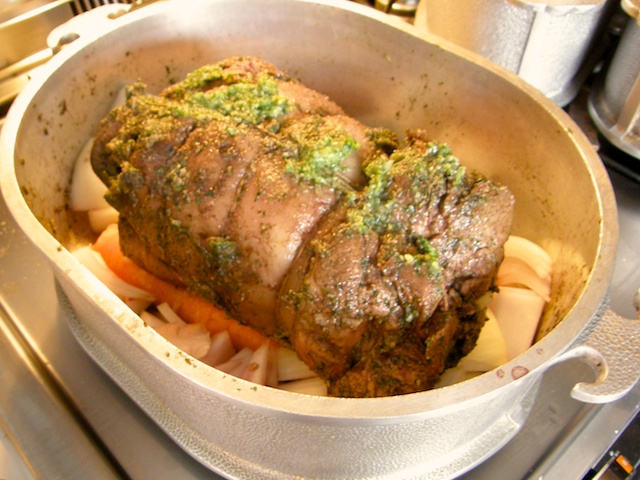
  6. Heat 1-2 Tbsp of olive oil in the Guardian Service Roaster over medium heat and coat bottom of pan well. Add the roast, searing each side for 90 seconds. Remove roast, add the halved carrots and quartered onion to the bottom of the roaster to form a cooking rack to support the roast. Return roast to pan, add any remaining garlic paste to the top,  and sprinkle generously with cider and wine.
  7. Cover and cook over medium low heat for 1.5 to 2 hours, depending on desired temperature of the finished roast. Allow to rest for 15 minutes, carve and transfer to the Guardian Service Roaster platter. Garnish with roasted carrot and onion and cover until ready to serve.
  8. Reduce the remaining roast and vegetable drippings over medium low heat, adding a tablespoon of cornstarch or flour mixed an equal amount of water or wine to the gravy to thicken, if desired. Serve with roast and vegetables.
Rubbing spices into the lamb

Adding the roast garlic-jalapeño-mint-parsley paste

Rolling and trussing the roast with kitchen twine

Searing all sides of the roast seals in the moisture
The prepared leg of lamb resting on a vegetable rack, ready cover and roast
For advice on preparing the carrots, potatoes and cabbage, visit our previous blog post on cooking vegetables the "Guardian Service Way."

Guardian Service Lemon Pound Cake
Adapted for the Guardian Service Duplex Utility Pan. Serve warm or cold. Make ahead, freezes well.
1/2 pound (2 sticks) butter
1/2 cup sugar, more if desired
4 eggs, beaten
2 lemons, juice and zest
3/4 cup milk
1/2 cup sour cream
2 1/2 cups flour
1 tsp baking soda
1 tsp baking powder
1/2 tsp salt
  1. Blend butter until creamy, add sugar, then eggs and lemon juice and zest.
  2. Sift together remaining dry ingredients and fold together with remaining wet ingredients.
  3. Spoon into heated, buttered Duplex Utility pan, close and cook for 13-15 minutes on medium low heat. Flip pan and cook additional 13-15 minutes.
  4. Remove from heat and allow to rest unopened an additional 10-15 minutes.
  5. Open pan and gently run a knife along the edge of the cake to loosen, remove to baking rack and cool. Slice and serve with fresh strawberries and yogurt.
Tasty cake, stove-top
Don't miss our other blog posts with recipe ideas for the Guardian Service Duplex Utility Pan and instructions for making Guardian Service Coffee.


Tuesday, September 28, 2010

Kettle/Canner Baking: Fig, Almond and Lavender Tart

The two pounds of fresh, organic, locally-grown figs seemed like a good idea when we bought them. We'd bake some yummy turnovers or maybe a little jam, we thought. But when the temperature skyrocketed over the weekend (peaking at yesterday's 113-degree thermometer–buster), we thought again, as firing up our drafty old oven now seemed like a very bad idea. I pulled out the Guardian Service Kettle/Canner and did some stovetop baking instead.

I adapted the recipe below from one by Barbara Wilde, whose l'Atelier Vert (Green Studio) is devoted to traditional French home and garden style. It makes a delectable treat—chewy, crispy, flaky and juicy—and the nut filling gives it higher ratios of protein and fiber and lower sugar and fat than your average dessert. If you serve it with yogurt, it's almost healthy.

Tarte aux Figues Provençal
Fig, Almond and Lavender tart 

2 c. almonds, blanched (or blanched hazelnuts or walnuts)
1/2 c. sugar
1 tsp. dried lavender, leaves and flowers
1 egg
1 tsp. Madeira (or pure vanilla or almond extract)
1 generous pound perfectly ripe black figs, cut lengthwise in quarters

2-3 Tbsp. sugar and dried lavender, for dusting
2 Tbsp. lavender honey (or mild floral honey), optional

1) Prepare a standard pâte brisée (pie dough) for a 9-10 inch crust. Shape it into a flattened round, wrap in wax paper and refrigerate at least 2 hours. Roll out and line a tart pan, prick all over, and place in freezer for at least half an hour.

2) Preheat Kettle over high heat for 10 minutes. Remove the crust from freezer, line with foil, and fill with dried beans or baking weights. Bake for 15-20 minutes, until the edges turn pale gold. Remove from oven, remove weights and foil, and reserve.

3) In a food processor, grind the almonds with the 1/2 cup of sugar. Add the lavender, egg, and Madeira, pulsing until it forms a paste. Delicately spread the mixture over the prebaked pastry shell.

4) Preheat Kettle over high heat. Arrange the fig slices in concentric, slightly overlapping circles. Sprinkle with 2 to 3 Tbsp. lavender sugar. Place tart on top baking rack and carefully lower into Kettle. Cover and bake over high heat for 30 minutes or until the figs darken and ooze a bit of juice. Remove tart and rack from the canner and let stand 10 minutes before serving. Optional: drizzle evenly with the warmed lavender honey and serve à la mode.

Monday, September 27, 2010

NY Times: America Hates Vegetables

Photo: Chris Martin
This weekend a NY Times article titled "Told to Eat Its Vegetables, America Orders Fries" was picked up as Huffington Post's lead story and subsequently around the blogosphere. Frankly, I pity the lot of them—the author and her interviewees. Kim Severson goes to great lengths to support a view that preparing vegetables is hard work, time-consuming and expensive. She writes:
People know that vegetables can improve health. But they’re a lot of work. In refrigerators all over the country, produce often dies a slow, limp death because life becomes too busy.
Now, I'll grant you, at the end of a long day, washing and chopping a head of broccoli can seem like a lot of work, might even seem time-consuming, but... really? She goes on:
In the wrong hands, vegetables can taste terrible. And compared with a lot of food at the supermarket, they’re a relatively expensive way to fill a belly.
If you boil a vegetable until it's dead, it will taste terrible. But to argue that "they're a relatively expensive way to fill a belly" is infuriating. Expensive relative to what? A triple-bypass? She goes on:
...a busy Manhattan resident who works for a pharmaceuticals company, would eat more vegetables if they weren’t, in her words, “a pain.”
“An apple you can just grab,” she said. “But what am I going to do, put a piece of kale in my purse?”
For weeks last March, the NY Times' most popularly emailed article was two simple recipes for that super health food, kale. Or, try an even simpler solution for a single serving on-the-go: Rip a few leaves of kale into bite-size pieces, muddle them with some salad dressing and chill them overnight. The acids in the dressing will "cook" the greens enough to make them a tender snack for lunch the next day. Stick that in your purse.
And the Times' last word? That summary statement is given to an analyst for a global marketing firm:
“Eating vegetables is a lot less fun than eating flavor-blasted Doritos,” said Marcia Mogelonsly, a senior analyst for Mintel, a global marketing firm. “You will always have to fight that.”
I admit that we have serious problems in our nation's "food deserts," where fresh produce is not readily available. And cooking for one person isn't easy, especially if you spend most of your day away from home. And, whether for one or a household, cooking requires planning and work.
This article promotes the idea that fresh-cooked vegetables have to defend themselves and compete in a marketplace with junk food and  panders to an America resigned to the Snack Food industry, deaf to social food movements and hopelessly addicted to greasy boxes of salty transgenic Frankenfoods.
We propose that perfectly cooked vegetables, crisp, juicy, abounding in flavor and nutrition and minimally processed (as is the Guardian Service Way) are incomparable to fast "food" and we invite writers and readers of the NY Times to take 15 minutes and try for themselves.

Saturday, June 5, 2010

Nutrition vs. Processed Food


Michele Simon recently wrote an article for alternet.org about the challenges facing Michelle Obama's "Let's Move" initiative to fight obesity. One of the biggest players in the Food Industry (PepsiCo) was first to claim support of the initiative and is looking for ways to make processed food "healthier." Simon sums up their dilemma:

"The company's problem comes down to this: PepsiCo makes processed food, which is no basis for proper diet in any culture. Nature provides true nourishment in the form of whole grains, fruits, and vegetables, and no corporate mantra can improve on that."
The complete article (here) details how PepsiCo's product lines are divided into three categories ranging from, "Good–for–you" to "Better–for–you" to "Fun–for–you." All in all, a compelling argument for the home cooked meal.

Wednesday, March 3, 2010

Hard and Soft-Boiled Eggs


Only a few egg recipes are included in the Guardian Service Tested Recipes cookbook: Scrambled Eggs, Guardian Omelet (I'll take a look at cooking omelets in the Guardian Service Duplex Utility pan in a future blog post), and a Tomato Flower Salad that calls for hard-boiled eggs, but no guidance on cooking hard or soft-boiled eggs in aluminum cookware. With Easter approaching it's the perfect time to offer some advice on the subject.

There's nothing remarkable about boiling an egg, but after years of cooking them, it amazes me when I still screw them up. Use too much heat or leave them to cook for too long and the yolks can green and the whites turn rubbery. As food nutritionist and Guardian Service advocate of the day Adelle Davis writes, "The texture of either a hard-cooked or a soft-cooked egg depends on the initial temperature of the water and the eggs, the number of eggs cooked, the amount of water used, the degree to which the utensil holds heat, the temperature to which the water is heated, and the length of time the eggs are left in it. If that is easy, I give up... The only way perfection can be obtained is to measure the water and to use a stop watch and a thermometer, none of which i expect a housewife to do."

I don't expect a housewife—nor any of us—to run his or her kitchen like a laboratory, but a few steps will help you get more consistent results: soft, mealy yolks and firm yet tender egg whites). And Guardian Service cookware is renowned for evenly retaining and distributing heat, which takes some guesswork out of the equation.
  1. Bring approximately 1 quart of water and 1 tsp vinegar (or lemon juice) to boil in the Guardian Service Dome Cooker (1.5 or 2 qt) or the Guardian Service Casserole Unit.
  2. Use room temperature eggs; slip carefully into water: 4 to 8 eggs*.
  3. Cover unit; simmer for five seconds and remove from heat. Let stand 8 minutes for soft-cooked eggs, 10 to 15 for hard-cooked eggs.
  4. Gently remove eggs and transfer to a bowl of ice water to arrest cooking.
*Eggs cold from the fridge? Alternately, you can begin with cold eggs in cold water, but you're less likely to get consistent results since there are more variables involved with the cooking time depending on everything from the outdoor temperature to that of your tap water. A trick which will also help to prevent cold eggs from cracking is to use a pushpin to create a small airhole in the larger end of the egg: "Its metal pinpoint is short enough not to rupture the membrane that separates the trapped air from the albumen but is thick enough to make a convenient hole for the air to escape through as it expands while being heated in the simmering water," writes Howard Hillman in Kitchen Science (Houghton Mifflin).

Pictured below: hard-boiled eggs on toast with sauteed tomato, onion and caper, accompanied by Niman Ranch bacon.

Some additional tips:

1) When cooking eggs in aluminum cookware, add 1 tsp of vinegar or lemon juice or 1/4 tsp cream of tartar to help prevent staining (caused by the hydrogen sulphide developed by heating the eggs). This aluminum oxide staining is harmless and can be removed by either cooking foods with high acid contents such as tomatoes, apples, lemon or rhubarb, or by boiling 2 tbsp of vinegar or 1 to 2 tsp of cream of tartar per quart of water, then polishing with soap-filled steel wool.

2) Never HEAT eggs, warm them. Writes Adelle Davis in the nutrition classic Let's Cook It Right, "If you submit eggs or cheese to high temperatures, the protein quickly becomes tough and some of its health-promoting value is destroyed. Cook booth cheese and eggs gently with low heat at all times."

3) Peeling a pain? Again, starting with simmering water and room temperature eggs helps when it comes to removing the shell, since the egg's albumen, or white membrane, retracts when the egg is carefully ladled into the simmering water. Older eggs (a week or more) will shell more easily, since their whites have already begun to shrink.

4) Perhaps most important of all: the source of the eggs themselves. If you haven't explored the difference in flavor and texture between a factory farmed egg and one from a pasture-raised hen, I invite you to do so. Pasture-raised hens have access to a natural diet of grasses, grubs and bugs; it was food for our grandmothers, it's food for you and me. And I'm less concerned with the cholesterol from a real food source than by what frankenfood dangers lurk in egg substitutes... besides, their both cholesterol and flavor FREE.

If you don't have your own backyard chicken coop (I did growing up and I long for the day I do again), look for eggs at farmers' markets or pasture-fed sources.