Showing posts with label coffee. Show all posts

Monday, September 12, 2011

Guardian Service Demonstration Dinner

In its day, Guardian Service ware was sold door-to-door, often at neighborhood parties where a salesman would prepare a demonstration dinner. Similar to the later Tupperware parties, the sales strategy relied on showing the product to the customer first-hand. The salesmen prepared and presented meals to highlight their pitch: the economic and nutritional advantages of waterless cooking the "Guardian Service Way." The hostess would receive a caddy of highball glasses with matching coasters or candlesticks or salt and pepper set, or other such gift. These dinners were often publicized with listings in the social register, such as the one pictured below.

A typical Guardian Service Demonstration Dinner notice
from the Granite Falls Press, WA (June 19, 1947)
Last week we recreated the Guardian Service Demonstration Dinner (while trying to keep our "Knights of Nutrition" proselytizing on medium low). We packed up the Guardian Service Roaster, Duplex Pan and Economy Trio Cookers, and the Beverage Urn and Coffee Maker and prepared a dinner for eight at our friend Nancy's home in Venice. Among those in attendance were our friend Dirk (who we discovered had sold waterless cookware in his college years) and Sam Watters (author of the LA Times' Lost LA feature on our Guardian Service cookware collection).

We wanted to cook an elegant dinner that would showcase the key advantages of Guardian Service Ware (the economy and nutrition of stove-top, waterless cooking) with fresh, local, seasonal fare, so we left planning the menu until we shopped our ingredients, starting with the cut of meat.

The family farm on which I was raised in North Dakota maintains a small herd of free-range beef cattle which are integral to its organic, bio-dynamic, self-sustaining ecosystem. Here in Los Angeles, we're fortunate to receive most of the red meat we consume from my family's farm, so we never really consider buying beef raised in a feed-lot Cowschwitz. Regular outbreaks of food-born illness have heightened public awareness of the health and environmental risks involved in raising and eating hormonally and genetically modified animals. Whenever possible, we look for a butcher who sources meat from ranches employing ethical, humane practices.

We've been reading and hearing about Lindy & Grundy for over a year and thought what better way to showcase the Guardian Service Roaster than with something special from this excellent charcuterie?

Proprietress Amelia Posada greeted us at the door with a friendly hello—fresh as milk, raven hair tied up in a red kerchief with Bow lips stained to match, a Rosie the Riveter of the Rib Roast. I told her what I had in mind and how many we were serving and she presented a butterflied leg of lamb, artfully trimmed and aged to perfection (and as with all their meats, local, pastured and organic). We'll be back to try the half beef/half bacon ground mix Amelia recommends for a blue cheese-topped burger…

As we shopped for produce at the Farmers Market at Fairfax and 3rd, I surfed some recipe sites for inspiration. All the local organic vegetables and spices we needed were available for the seasonal Persian lamb dish below. We altered a few ingredients from the original recipe, roasting the garlic and jalapeño in advance to mellow and sweeten their effects on the meat.

We prepared one pot each of carrot coins, red and white new potatoes and red and white cabbage in the Guardian Service Economy Trio Cookers (or "triangle pans" as they're often called). And for dessert: a lemon pound cake cooked stove-top in the Duplex Utility Pan, topped with fresh strawberries muddled with brown sugar and plain yogurt and served with Guardian Service Coffee.

Roast Garlic Stuffed Leg of Lamb
inspired by Fakdeh Mehshi Khodra

2 cups chopped fresh flat-leaf parsley
1 cup chopped fresh mint leaves
25 cloves garlic, peeled, roasted and mashed
2 Tbsp olive oil
1/2 tsp finely chopped jalapeño pepper
2-3 carrots, sliced in half lengthwise
1 large onion, quartered
1/2 tsp ground allspice
1/2 tsp grated nutmeg
1/2 tsp ground cloves
1 tsp fresh ginger, minced
2 tsp salt
1 tsp black pepper
4 1/2 pounds boneless leg of lamb, butterflied, trimmed of excess fat, rinsed, and patted dry
1 pound onions, halved
1/4 cup apple cider vinegar
1 cup red wine*
1 Tbsp cornstarch or flour

*Verjus, a sour grape juice, is traditional for a Muslim recipe. Vinegar and wine are a fine substitute.

  1. Lightly coat 2 dozen peeled garlic cloves in a small or medium sized pot. Cover and place over medium high heat for 5 minutes, until lid is warm to touch, reduce heat to low and roast for 30 minutes, shaking pot occasionally to keep cloves from sticking.
  2. Add minced jalapeños and continue to roast additional 5-10 minutes. Remove pot from heat and allow to cool.
  3. Using a food processor or blender, blend the roast garlic and jalapeño together with chopped mint and parsley and set aside.
  4. Rub the dry spices and ginger into the prepared cut of meat, massaging well.
  5. Spoon a ribbon of the garlic paste into the center of the cut and roll into a roast, securing with kitchen twine.
  6. Heat 1-2 Tbsp of olive oil in the Guardian Service Roaster over medium heat and coat bottom of pan well. Add the roast, searing each side for 90 seconds. Remove roast, add the halved carrots and quartered onion to the bottom of the roaster to form a cooking rack to support the roast. Return roast to pan, add any remaining garlic paste to the top,  and sprinkle generously with cider and wine.
  7. Cover and cook over medium low heat for 1.5 to 2 hours, depending on desired temperature of the finished roast. Allow to rest for 15 minutes, carve and transfer to the Guardian Service Roaster platter. Garnish with roasted carrot and onion and cover until ready to serve.
  8. Reduce the remaining roast and vegetable drippings over medium low heat, adding a tablespoon of cornstarch or flour mixed an equal amount of water or wine to the gravy to thicken, if desired. Serve with roast and vegetables.
Rubbing spices into the lamb

Adding the roast garlic-jalapeño-mint-parsley paste

Rolling and trussing the roast with kitchen twine

Searing all sides of the roast seals in the moisture
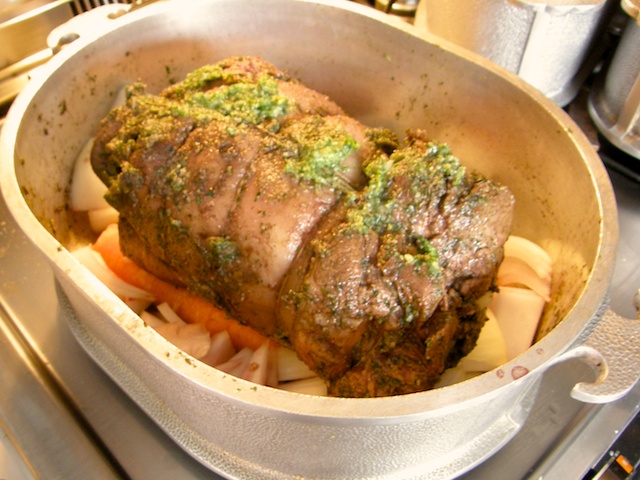
The prepared leg of lamb resting on a vegetable rack, ready cover and roast
For advice on preparing the carrots, potatoes and cabbage, visit our previous blog post on cooking vegetables the "Guardian Service Way."

Guardian Service Lemon Pound Cake
Adapted for the Guardian Service Duplex Utility Pan. Serve warm or cold. Make ahead, freezes well.
1/2 pound (2 sticks) butter
1/2 cup sugar, more if desired
4 eggs, beaten
2 lemons, juice and zest
3/4 cup milk
1/2 cup sour cream
2 1/2 cups flour
1 tsp baking soda
1 tsp baking powder
1/2 tsp salt
  1. Blend butter until creamy, add sugar, then eggs and lemon juice and zest.
  2. Sift together remaining dry ingredients and fold together with remaining wet ingredients.
  3. Spoon into heated, buttered Duplex Utility pan, close and cook for 13-15 minutes on medium low heat. Flip pan and cook additional 13-15 minutes.
  4. Remove from heat and allow to rest unopened an additional 10-15 minutes.
  5. Open pan and gently run a knife along the edge of the cake to loosen, remove to baking rack and cool. Slice and serve with fresh strawberries and yogurt.
Tasty cake, stove-top
Don't miss our other blog posts with recipe ideas for the Guardian Service Duplex Utility Pan and instructions for making Guardian Service Coffee.


Tuesday, August 23, 2011

Strawberry Shortcake in the Guardian Service Duplex Utility Pan

Most often this hinged pan is used to prepare omelets (and it will, indeed reward you with lofty, golden omelets once you understand its eccentricities). But the marketing team of the Century Metalcraft Corporation dubbed it The Guardian Service Duplex Utility Pan for a reason. True to its "Kitchen of Tomorrow" name, the pan works as mini-Dutch oven to cook up a meal for two quickly and fuel-efficiently. We like putting the pan through its paces (and have adapted it for various uses) but these quick biscuits prove one of the best: the entire dessert takes less than 30 minutes to prepare, from assembling ingredients to presentation.

I've adapted the Shortcake recipe from the Guardian Service Tested Recipes cookbook to yield enough dough for two large biscuits. While I replaced the shortening in the recipe with butter and reduced the sugar slightly, the biscuits turned out light and fluffy (make sure not to over-handle the dough—rolling and shaping with your hands is sufficient).

Freshly whipped heavy cream is traditional (perhaps with a drop of brandy and scant sugar) but here I've substituted a yogurt sauce (scented with agave nectar, nutmeg and vanilla and added a drizzle of pomegranate molasses to the berries in place of a sugar glaze.


Guardian Service Strawberry Shortcake
The classic summertime dessert adapted for the Guardian Service Duplex Utility Pan

1 cup flour
2 tsp baking powder
2 Tbsp sugar
pinch salt
2 Tbsp cold butter, diced (plus more for pan)
1/3 cup milk
1 egg
1 dozen fresh organic strawberries, sliced
2 Tbsp pomegranate molasses (optional)


Low-Fat Yogurt Sauce
1 cup low-fat yogurt
2 Tbsp. agave nectar
1/2 tsp. pure vanilla extract
pinch fresh–ground nutmeg


  1. Mix dry ingredients (flour, baking powder, sugar, salt)
  2. Cut cold butter into flour. Beat egg, add to milk and mix into flour with pastry blender.
  3. Turn out onto floured board, roll and shape into biscuits by hand, using a light, deft touch.
  4. Heat Duplex Utility pan, add butter and drop biscuits into pan.
  5. Close lid, cook for 8-10 minutes until bottoms are browned. 
  6. Open pan, heat opposite side, add pat of butter and coat pan. Close lid, flip pan and brown biscuits on other side.
  7. Remove biscuits from pan, halve and fill with strawberries, top with yogurt sauce.


The complete Guardian Service dessert: Strawberry Shortcake and Coffee


Tuesday, August 3, 2010

Guardian Service Backyard Tandoori


We were spared the scorching temperatures that socked most of the nation last month, but yesterday's warmer weather drove us out of doors rather than face heating up the kitchen for dinner. Our improvised meal was not only memorably delicious, but a solid adaptive use of Guardian Service cookware—a Pan-Asian Fusion meal undreamed of by the cookware's designers, yet one that honors their tenets of nutrition and economy in our common pursuit of "Good Health, Pleasure and Profit."

This method is inspired by tandoori* cooking, though instead of a clay oven, we use a portable 14 1/2" charcoal grill and our Guardian Service Casserole unit. When the coals are hot, the Casserole unit builds up a head of steam, gently cooking the vegetables at the grill's center, while the meat is grilled on the perimeter. The seared meat is then added to the mix. As the fire cools, it finishes the meal at the perfect low temperature required for "waterless cooking" with Guardian Service Ware.

Guardian Service Backyard Tandoori
(Five basic steps. Try any combination of vegetables and/or meats.)
  1. Marinate the meat or fowl.
  2. Layer the vegetables in the Casserole unit according to cooking time required—fibrous vegetables (carrots, celery, turnips, parsnips) in a "basket" layer (the bottom and sides), starchier vegetables (potatoes, sweet potatoes) to the center and the juicier, more delicate vegetables, which require little to no cooking, on top (tomatoes, onions, cauliflower, peppers).
  3. Place the covered unit over a small amount of charcoal (12-15 briquettes) in the center of the grill.
  4. Grill the meat: place the pieces of marinated meat around the outside edge of the grill, searing the outside edges until brown. (We use the Guardian Service Economy Trio trivet to prevent grill marks from burning into the Casserole, but it's not a necessity).
  5. As the meat browns, place each seared piece into the Casserole along with any remaining marinade and cover. Finishing cooking for 30 minutes.


Note the color retention in the vegetables (and thus nutritional retention) from start to finish. The low, constant, contained heat of the waterless cooking method creates an incredibly nutritious meal and works wonders with inexpensive cuts of meat and any variety of vegetables and sauces.


Andrew improvised a Chicken Masala Tandoori last night employing the above method (carrots, sweet potatoes, heirloom tomatoes, cauliflower, jalapeño peppers, scallions, basil and chicken thighs marinated in Masala Sauce  with sesame oil, juice of half a lemon, juice of half an orange, salt and pepper). Served withbread and chutney. Bon Appétit!

Chef Andrew. Not only does he cook an outstanding meal, but he suffers this dopey apron. And he's kinda cute too... I guess he can stick around.
*A true tandoor is made of clay and is used throughout India, the Middle East and Central Asia and employs high temperature cooking in a cylindrical clay oven or a grill. Andrew combined the grilled, smoked effects of tandoori cooking, with the slow, low heat requirements of Guardian Service Ware.
* * * * * * *
Stretch the fuel economy even further? As dinner was served, we placed a carafe of water over the remaining coals, enough fuel to bring it to a boil and brew a pot of Guardian Service Coffee (with dessert accents of fennel and cinnamon added to the grounds).

Friday, June 25, 2010

Coffee, the Guardian Service Way

We found the coffee pot, caked with dust, in one of those about-to-close antique shops that seem to fade in and out of existence. The stacked shelves and darkened aisles were laden with a lifetime's acquisitions (or its remaining shards) and the stepdaughter of the dead proprietress was anxious to part with anything for about ten bucks.

I picked up the weighty-looking urn, surprised by how relatively light it was, turned it over and saw the embossed logo: a knight's helmet and the words "Guardian Service." We brought it home, polished it up and Aladdin-like, the djinni of our mid-century cookware obsession was unleashed, inspiring a deeper food philosophy and eventually this blog.


While passionate about savoring a proper cup of coffee brewed the Guardian Service Way, I admit that most mornings I grope my way to the kitchen and switch on the automatic Krups, more interested in hastening its effect than enjoying its flavor. But on slow mornings or with "farmhouse breakfasts," this method brings out a deep range of scents and flavors and makes one toothsome cup of Joe.

The complete Coffee Maker/Beverage Urn has five pieces total: the Beverage Urn and lid (as with all Guardian Service ware, the pre-War models had metal lids which were later replaced by glass) and the "Dripper" unit (with filter and water distributor). You'll also need a separate kettle in which to boil the water.

From Betty Gay's "Guardian Service Tested Recipes," the proper method for making coffee in the Guardian Service Ware Coffee Maker:

Guardian Coffee
"Served piping hot to the last delicious drop... a happy ending to any meal."


"You've heard the one about coffee—How one morning it's strong enough to stand alone and the next morning too weak to get up. Not so, when prepared the Guardian Way, for coffee clear, sparkling and full of the natural aroma of the roasted bean will be yours every time. Your Guardian Service Coffee Maker and Beverage Urn prepares coffee by a method that science is proving most satisfactory for flavor, health and economy. It is graceful in design and so convenient for service coffee, as well as other hot and cold beverages at the table."

"Guardian Consistently Good Coffee"

  1. Heat the beverage urn by rinsing with hot water.
  2. Place dripper in top of urn and put filter disc with seam side down in bottom of dripper.
  3. Measure into dripper, 2 teaspoons (1 level tablespoon, if a richer flavor is desired) of standard or drip grind coffee per cup. Do not use pulverized coffee*.
  4. Place water distributor over coffee, pressing down firmly but not tight.
  5. Pour in actively boiling water to desired measure. Use fresh cold water brought to a rolling boil. (Dripper is marked 2–4–6–8 cups.) For ten cups, measure proper amount of coffee in dripper, add eight cups of boiling water and when filtered thru, add 2 cups clear boiling water and mix.
  6. Cover and place over very low heat or on warm part of stove. Allow about 1 minute per cup for coffee to drip.
  7. When coffee has dripped thru, remove dripper, place cover on urn, adjusting cover with long flange in front of spout to retain heat.

Note: When using urn for table service, place a mat or table tile underneath to protect table from heat. Use Guardian Urn for various iced drinks. During the summer weather especially, the Guardian Urn will do double duty as a beverage pitcher. It acts as a "thermos" container for cold drinks as well as hot.


Iced Coffee: Prepare coffee double strength, cool to room temperature, Fill tall glasses half full of cracked ice or use 2 ice cubes. Pour coffee into glasses. Serve with cream, pass sugar syrup in a pitcher for sweetening (a spoon of whipped cream or a scoop of ice cream in each glass is a welcome addition).

*Some espresso grinds may work, but pulverized varieties like Turkish or Greek coffee may leave a gritty finish.